Dependable document delivery on the Customer Portal
▸The Customer Portal now always serves the last approved version of a document — uploading a new draft never changes what your customers see until you approve it, and a document being revised keeps showing its previous approved version instead of disappearing.
▸Withdrawing (marking obsolete) a published document now automatically removes it from the Customer Portal, so retired content can never linger in front of customers.
▸Document and portal downloads are more resilient under load: if the document store is momentarily busy, a download now responds promptly instead of stalling — simply retry.
▸In-app Help and the End-User Guide refreshed to cover these changes, with per-page permission guidance throughout.
SynthQMS™ —
the platform medical-device companies actually run on.
The integrated QMS + CRM control plane. Document control,
training, audits, CAPAs, complaints, MDR, management review,
design change — all the ISO 13485 / 21 CFR Part 11
structural pieces. Plus accounts, contacts, leads, pipeline,
estimates, invoices, time/expense, support tickets, and the
Booth PWA for trade-show lead capture.
Not a medical device itself — this is platform tooling.
Built by a medical-device company for medical-device
companies, used internally to run Synthology, made available
as a standalone product. SynthQMS is the system of record
behind every other product page on this site.
SynthQMS is platform tooling, not a medical device. The
distinction matters: the products on the Synthology family
list (XyDromatics Router, the archive family, SR Engine, etc.)
are non-device software under FD&C Act
§520(o)(1)(D). SynthQMS sits one layer up —
it’s the system that helps you operate an
ISO 13485–aligned medical-software business
compliantly. Different category, different evaluation
criteria.
SynthQMS IS
An integrated QMS + CRM platform
Aligned with ISO 13485, 21 CFR Part 11, SOC 2
Cross-platform (Windows + Linux)
Standalone-licensable
The platform Synthology runs on internally
SynthQMS IS NOT
A medical device of any classification
A device-submission target (it is general-purpose business software with no clinical function)
A clinical-decision system
A replacement for clinical EMR / EHR systems
A multi-tenant Synthology-hosted SaaS (single-tenant deployments are standard)
The full ISO 13485-structured QMS module set. Each module
covers an ISO clause-and-companion-21-CFR section directly;
auditors walking the system find the artifacts they expect
to find.
Document control
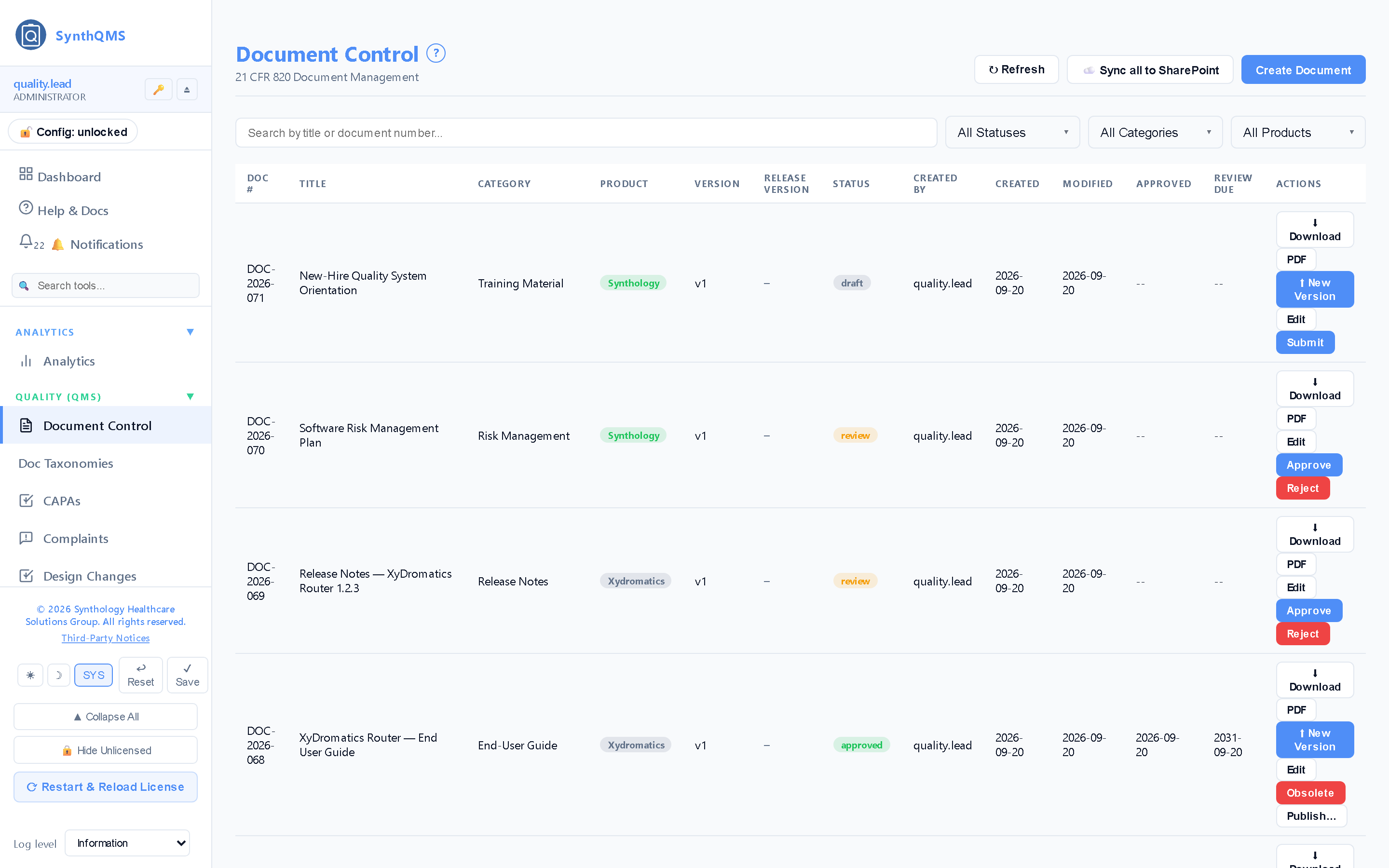
The core QMS function — controlled documents with version history, approval workflows, and immutable audit. Every document has a DOC-YYYY-NNN number, a SHA-256 content hash on every approved version, and an audit-trail entry for every state transition.
Draft → review → approve → archive workflow
SHA-256 content hashing on every approved version
Required-reason text on every state transition
Draft → review → approve, with the approving user and timestamp recorded on every approved version (two-person co-sign is enforced separately, on generation of gated licences)
SharePoint mirror so the authoritative copy survives a host wipe
DOC-YYYY-NNN auto-numbering
Training records
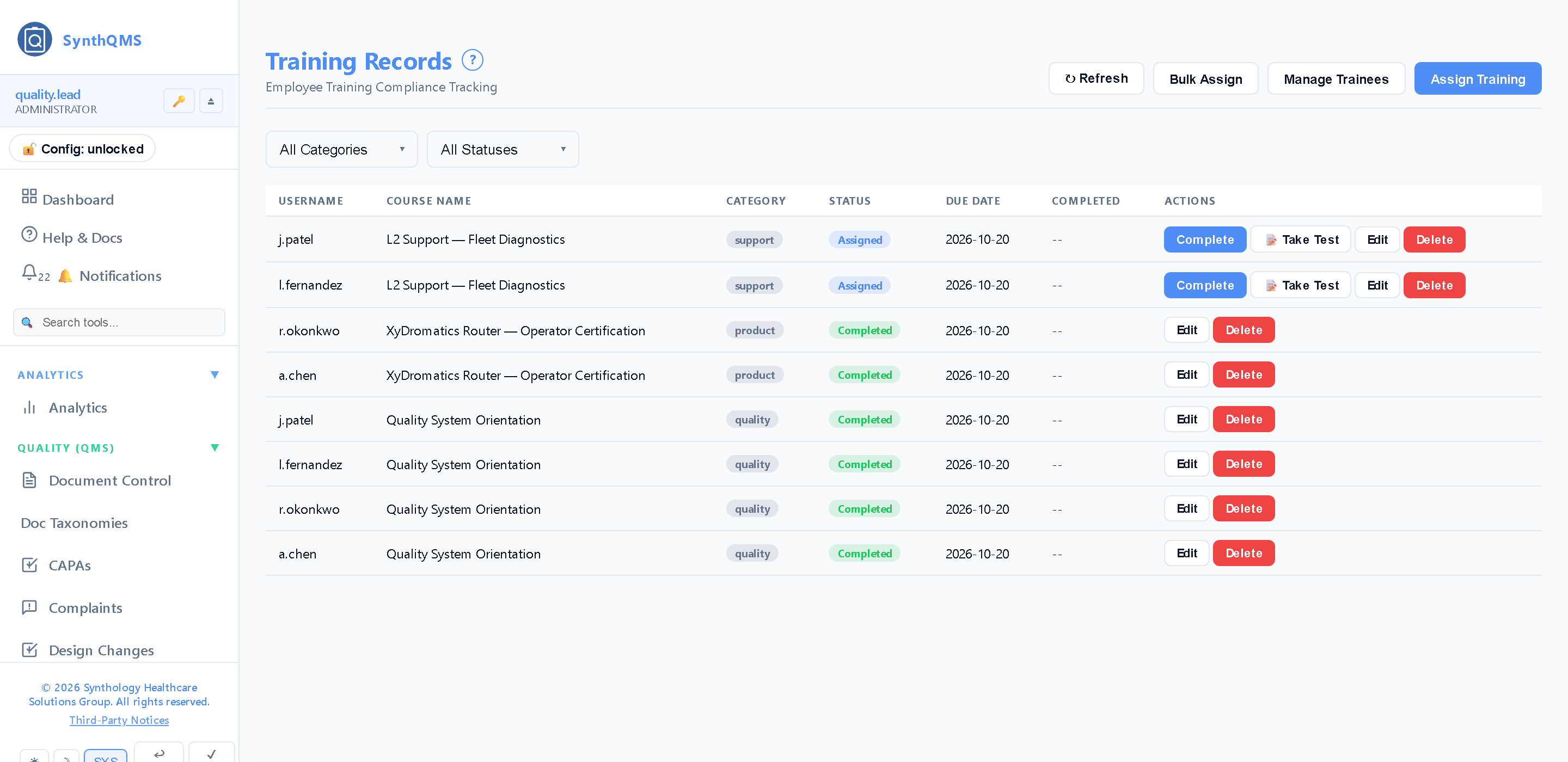
ISO 13485 §6.2 demands training records. SynthQMS captures who has been trained on which document, when, with competency verification.
Per-user training assignments with course, category, due date, competency score and completion certificate
Read-and-acknowledge workflow with audit trail
Competency-assessment records (didactic + lab where applicable)
Training-due notifications for upcoming renewals
Due dates with automatic overdue detection and notification; refreshers are re-issued by bulk-assigning the course to a user list
Training-completion exports for audits
Internal audits
Schedule, execute, and close internal audits. Findings tracked through to remediation with full traceability into CAPAs where applicable.
Audit-program scheduling with annual / semi-annual cadence
Audit-checklist authoring with controlled-document linkage
Auditor + auditee identity capture
Findings catalog with severity classification
Linkage to CAPAs for findings requiring corrective action
Audit closeout package generation for inspections
CAPAs (Corrective + Preventive Action)
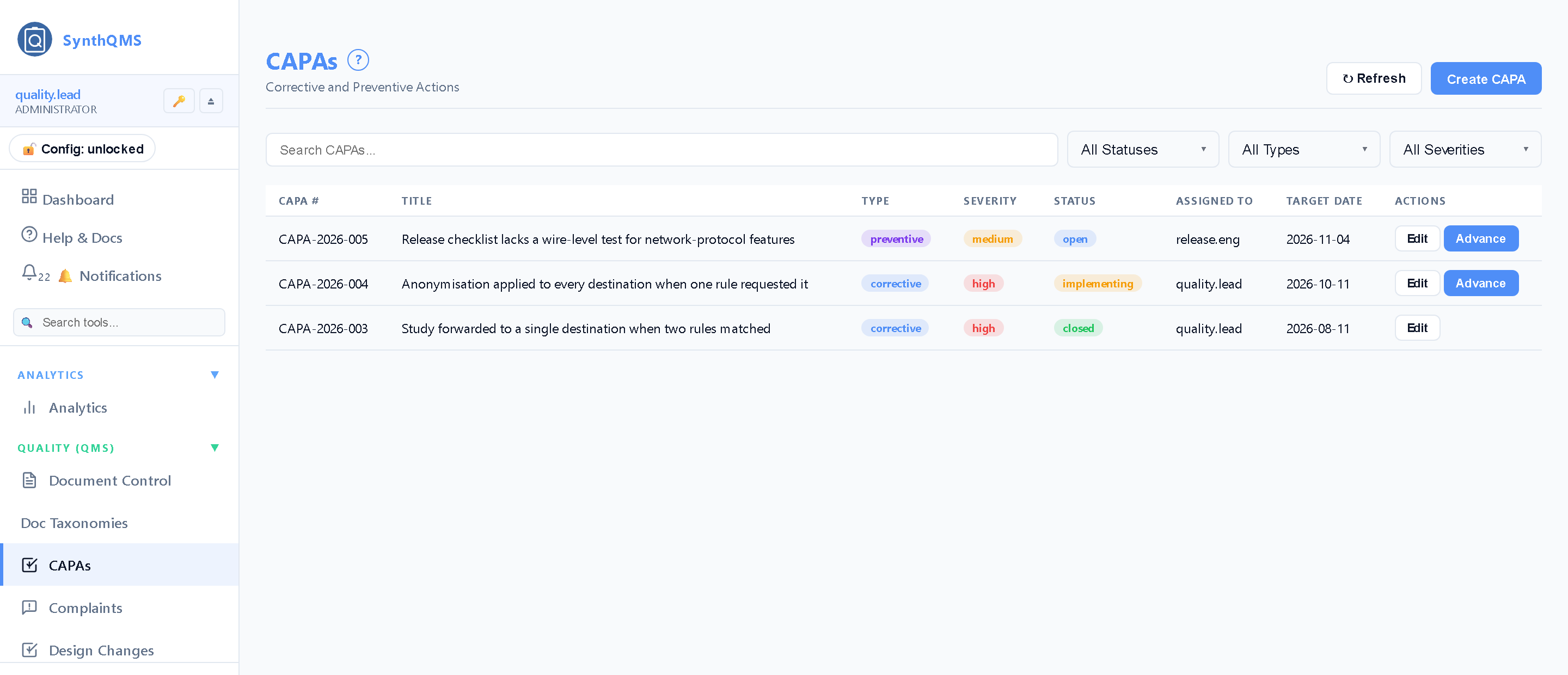
The lifecycle of a CAPA from initiation through closure. Required artifacts at each step; nothing closes without complete documentation.
Root-cause analysis workflow with required documentation
Action plan with owner + target date
Effectiveness verification (did the fix actually work?)
Closure with two-person sign-off
Linkage back to the triggering source (audit / complaint / etc.)
Complaints + MDR (Medical Device Reporting)
Customer complaints captured with structured intake; MDR-eligible complaints flagged for FDA reporting per 21 CFR 803.
Complaint intake with structured patient-impact assessment
MDR-eligibility decision workflow with documented rationale
MDR record-keeping: 24-hour reportability triage, approval workflow, and capture of the FDA report number and submission date after filing' (and correct SynthQMS help-content.js:49 and :179, which make the same unbacked eMDR-export claim in-app)
Trend analysis across complaint categories
Linkage to product lots / released versions
CAPA-trigger flow when complaints indicate systemic issues
Design change control + Released Versions
Design Change Records (DCRs) tracked through approval. Released-version catalog with supersedes-chain and tombstone semantics for go-live cleanup.
Design Change Record (DCR) workflow with impact assessment
Linkage to affected controlled documents + risk-management files
Released-version catalog (per product, per version)
Soft-delete (tombstone) for stale versions with supersedes-chain
SHA-256 hash + authoritative artifact storage in SynthVault
Per-version documentation archive
Management Review
ISO 13485 §5.6-required Management Review records. Quarterly cadence with structured agenda, attendees, decisions, action items.
Per-meeting structured record with required-element checklist
Attendee tracking (multi-select against user roster)
Inputs: audits, CAPAs, complaints, MDR, customer feedback, training status
Outputs: decisions, action items with owners + due dates
Linkage from Management Review action items into CAPAs / DCRs
Annual Management Review summary export for inspections
The integrated CRM that distinguishes SynthQMS from the
QMS-only incumbents. Customer / contact / pipeline / billing /
support all in one platform with the QMS — no separate
system, no integration seam between Quality and Revenue.
Accounts + contacts
Customer / prospect / partner records with full contact graph. Same data model that the QMS Complaint module ties to (customer-of-record on every complaint).
Account records with tier classification + relationship status
Multiple contacts per account, each with a contact role (IT admin, PACS admin, radiologist, purchasing); customer-portal access is granted per account through the portal roles
Account-level installation tracking (which products at which sites)
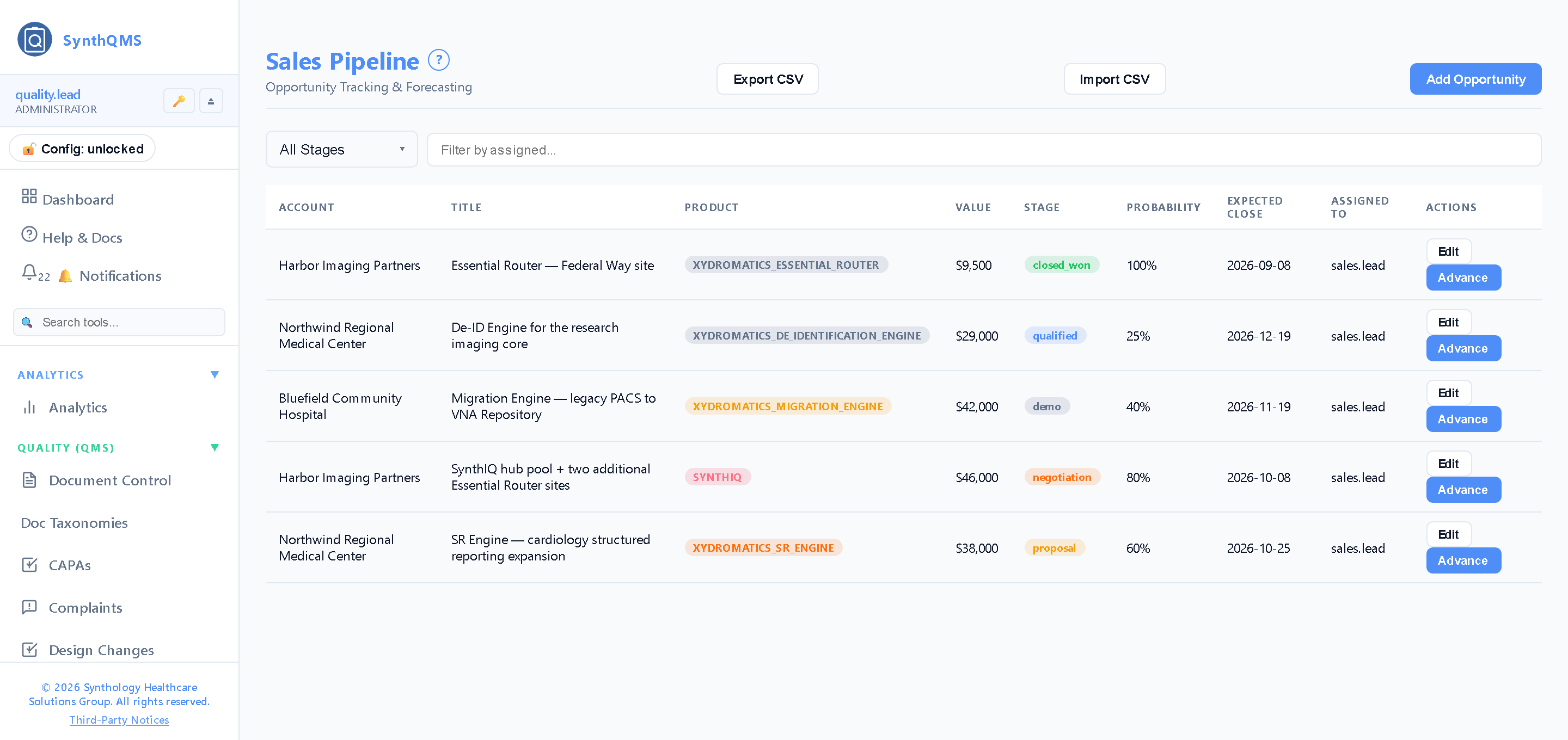
Lead capture, qualification, and pipeline progression. Booth-PWA-captured leads land here directly; web form captures here; email-driven leads capture here via Microsoft Graph.
Lead capture from web form, Booth PWA, email auto-ingest
Lead-source tracking (channel attribution)
Qualification workflow with disposition codes
Conversion to account + opportunity
Pipeline stages with weighted-revenue forecasting
Pipeline list filterable by rep and stage, an owner revenue leaderboard, and lead-source attribution captured on every lead (pipeline stage counts, weighted value and win rate are org-wide totals)
Estimates + invoices + billing
Quote-to-cash workflow integrated with the product catalog. Estimates use catalog pricing; invoices flow to QuickBooks Online or Xero.
Estimate authoring with product-catalog pricing + service line items
Customer-approval workflow with magic-link signoff
Invoice generation from approved estimates
QuickBooks Online integration (QBO Sync)
Xero integration (alternative to QBO)
Time-and-Expense capture with customer-signoff workflow
Tickets + support
Active-customer support ticket queue with SLA tracking. Linkage to Complaints when a ticket reveals a complaint-eligible issue.
Ticket intake from support@ inbox via Microsoft Graph email-ingest
SLA tracking with response + resolution timers
Per-customer ticket history
Knowledge-base linkage for self-service
Escalation workflow for sev-1 incidents
Trigger flow from ticket → Complaint when applicable
Booth PWA (trade-show lead capture)
A progressive-web-app for trade-show booth lead capture. Scan a badge QR code; lead lands directly in the pipeline. Designed for the chaos of a busy booth.
PWA installable on phones / tablets at the booth
QR-code badge scan → lead record creation
Free-text follow-up notes per lead
Cloudflare Tunnel-based remote-sync (works at convention WiFi)
Multi-device sync across the booth team
Post-event lead-quality review and assignment
Integrations & cross-cutting features
Audit trail, Microsoft Graph, SharePoint, accounting.
The integration surface that makes SynthQMS practical to
operate — not a walled garden. Email lands as tickets and
activity records; documents mirror to SharePoint; invoices
flow to QuickBooks Online or Xero; everything carries an
audit trail.
Audit trail (21 CFR Part 11-aligned)
Every action in SynthQMS — every state transition, every document approval, every CRM update — captured in an audit trail aligned with 21 CFR Part 11 expectations for electronic records.
User identity + timestamp on every action
Required-reason text on regulated state transitions
Two-person sign-off (electronic signatures per Part 11 §11.50)
Hash-chain audit log (tamper-evident)
Audit-record export for inspections
Retention policies aligned with longest-applicable regulatory window
Microsoft Graph integration
Email ingestion + activity tracking via Microsoft Graph. Inbound emails to support@ / sales@ / regulatory@ etc. land as tickets, leads, or activity records automatically.
Microsoft Graph subscription on shared mailboxes (Sales, Support, etc.)
Email-to-ticket automatic intake
Activity-tracking from email threads to account/contact records
Outbound email via Graph (preserves Sent-Items in the canonical mailbox)
Local accounts with RBAC, plus optional LDAP / Active Directory bind
Privacy posture per DOC-2026-198 + DOC-2026-199 (controlled documents)
SharePoint document mirror
Authoritative QMS documents mirror to SharePoint automatically. Off-host backup; survives a SynthQMS host wipe. One-way sync (SynthQMS authoritative).
Per-controlled-document SharePoint mirror
Automatic mirroring on every approved version
Manual "sync all" admin action for re-mirroring after drift
DocumentStorageType="both" — local + SharePoint
Off-host disaster-recovery posture
Accounting integration (QBO + Xero)
Invoices flow from SynthQMS into the customer's accounting system without manual re-entry. QuickBooks Online or Xero, customer's choice.
Corrective and preventive actions from root cause to verification of effectiveness, each linked to the complaint, audit finding or design change that raised it.
Pre-revenue or early-revenue medical-device company that needs ISO 13485-structured QMS infrastructure quickly — without the heavyweight cost of MasterControl, Greenlight Guru, or Veeva. SynthQMS gives you the regulatory framework with a CRM bolted in for sales operations.
3Week 2-4: CAPA + complaint workflows configured per institutional process
4Month 2: first internal audit run through the system
5Month 3: Management Review captured natively
6Annual: external ISO 13485 audit walks the SynthQMS audit trail end-to-end
Pattern 2
Combined QMS + CRM for a mid-sized med-device org
Mid-sized company already running a separate CRM (Salesforce, HubSpot) and a separate QMS (MasterControl, Greenlight Guru). Consolidate to SynthQMS for the integration benefit — Complaints linked to Accounts; CAPAs linked to product lots; Tickets that turn into Complaints flow naturally.
Flow
1Discovery + scope: which workflows currently span the QMS-CRM seam
2Migration: Account / Contact data from existing CRM; controlled documents from existing QMS
3Cutover phased by department (regulatory first, then sales, then support)
4Integration tightening: Complaints ↔ Accounts ↔ released versions all connected
5Annual review: substantial savings from one license + one ops surface
Pattern 3
Synthology-product customer using SynthQMS for their own QMS
A hospital or imaging-IT vendor running XyDromatics products who also wants SynthQMS for their internal QMS. Cross-product audit trails span the deployment — Complaint about a XyDromatics product flows naturally into the Complaints module.
Flow
1XyDromatics product complaints captured in SynthQMS Complaints module
2MDR-eligibility flagged for relevant complaints
3CAPAs triggered when complaint patterns suggest systemic issues
4Released-version catalog tracks which version of which XyDromatics product is at which customer site
5Audit trail spans the whole loop
Pattern 4
Trade-show lead capture (Booth PWA)
A vendor with a booth at HIMSS, RSNA, or another trade show. Booth PWA replaces paper lead-capture sheets and the post-show "type-everything-into-the-CRM" data entry day.
Flow
1Pre-show: Booth PWA installed on team phones / tablets, Cloudflare Tunnel configured
2Day-of: scan badge QR codes at the booth; leads land in pipeline directly
3Free-text follow-up notes per lead during the conversation
4Multi-device sync across the booth team
5Post-show: leads triaged + assigned without re-entry
System requirements & sizing
Sized to organization scale.
Most SynthQMS deployments fit comfortably on a small VM.
SynthQMS runs as a single application instance; where the QMS is
operationally critical, availability is provided at the PostgreSQL
tier using whatever HA configuration your database team already
operates.
Tier
Scale
CPU
RAM
Typical org
Small (single team)
< 25 users · < 500 docs
2 vCPU
4 GB
Early-stage med-device company, single regulatory team.
Mid-sized organization
25 – 250 users · 500 – 5,000 docs
4 vCPU
16 GB
Growing med-device company with sales operation, customer support, multiple product lines.
Large organization
250 – 1,000 users · 5,000+ docs
8 vCPU
32 GB
Multi-product med-device company with broad customer base and active support operation.
Enterprise
1,000+ users
16+ vCPU
64 GB
Large IDN, contract research org, multi-entity holding company.
Licensing
Three packages, modular tiers.
Core covers the full QMS function. The +CRM tier adds the
integrated CRM; Enterprise adds the Booth PWA and multi-tenant
separation.
SynthQMS Core
The base QMS — document control, training, audits, CAPAs, complaints, MDR, management review, design change control. Quality function only.
All QMS modules (document control / training / audits / CAPAs / complaints / MDR / management review / design change)
21 CFR Part 11-aligned audit trail
SharePoint document mirror
Microsoft Graph email integration (Activity Tracking)
Sizing, OS support (Windows + Linux), database options
Pending
EULA Annex (SynthQMS)
Annex to the Synthology Master EULA (DOC-2026-063)
Pending
SynthQMS Implementation Guide
Configuration patterns for ISO 13485 + 21 CFR Part 11 alignment
DOC-2026-198
Email Monitoring Policy
GDPR / CCPA / NLRA / HIPAA basis for the Activity-Tracking feature
DOC-2026-199
CRM Activity-Capture Policy
Companion to DOC-2026-198 for CRM-side activity capture
Pending
SynthQMS User Guide
Operator + administrator + auditor workflows
Pending
Installation Guide (SynthQMS)
MSI deploy + Linux tarball + database setup
Pending
Penetration Test Results (SynthQMS)
Available under NDA
Rows listed as Pending are not yet authored or
registered in SynthQMS itself — meta of meta.
Frequently asked
The questions buyers ask.
Why is SynthQMS on the products page if it isn't a medical device?
Because customers buy it. SynthQMS is the integrated QMS + CRM control plane Synthology runs on internally; it's also a standalone product available to other medical-device companies, imaging-IT vendors, and any organization that needs ISO 13485-structured QMS with a CRM bolted in. Not a medical device itself -- it's the platform that helps you operate your medical-device business compliantly. Different category from XyDromatics; same family.
Does SynthQMS require any other Synthology products?
No. SynthQMS is fully standalone-licensable. Many customers buy it without any XyDromatics products. The integration benefit when you DO run XyDromatics products is that complaints / MDRs / released-versions for those products flow naturally into SynthQMS without separate tooling. But the QMS + CRM functions stand on their own.
How does it compare to MasterControl, Greenlight Guru, Veeva, Qualio, etc.?
SynthQMS lives in a slightly different niche. The big incumbents (MasterControl, Veeva) are purpose-built QMS platforms with deep regulatory tooling and high price points; they typically don't have CRM. The lighter QMS-as-SaaS players (Greenlight Guru, Qualio) are accessible for early-stage med-device but also QMS-only. SynthQMS combines QMS + CRM in one platform, ships cross-platform (Windows + Linux), and comes with the Booth PWA for trade-show lead capture and the accounting integrations (QBO + Xero) that growing companies actually need. Different sweet spot from the QMS specialists, but operationally simpler for organizations whose revenue function and quality function are run by overlapping teams.
Is SynthQMS 21 CFR Part 11 compliant?
SynthQMS is 21 CFR Part 11-aligned: electronic-signature support per §11.50 with required-reason text, two-person sign-off where applicable, audit trails per §11.10(e), and tamper-evident hash-chain audit logs. Whether your specific deployment meets Part 11 in practice depends on your configuration, your training program, your validation package, and your operational discipline. SynthQMS gives you the technical foundation; the compliance program is yours to maintain. Same as every QMS product -- "Part 11 compliant" is a property of how you run the system, not just what the system can do.
Does SynthQMS support ISO 13485?
Yes, structurally. The module set maps directly to ISO 13485 clauses: §4.2 document control, §6.2 training records, §7.3 design change control, §8.2 customer feedback / complaints, §8.5 CAPAs, §5.6 management review. Auditors walking the system find the artifacts they expect to find. SynthQMS is used internally to run our own ISO 13485-aligned QMS, so the eat-your-own-dogfood validation is built in.
What about SOC 2?
SynthQMS's controlled-document workflow, RBAC, audit trail, and change-management surface are exactly the controls a SOC 2 audit walks. Synthology's own SOC 2 Type II readiness program (DOC-2026-253) treats SynthQMS as the system of record for the control framework. Customers running SynthQMS inherit that structural fit.
Where does the data live? Cloud or on-prem?
Both, customer's choice. SynthQMS deploys cross-platform (Windows + Linux) against PostgreSQL, and works on-prem, customer-cloud, or in a Synthology-managed deployment. The SharePoint document mirror gives an off-host backup wherever the primary deployment lives. We do NOT operate a multi-tenant Synthology-hosted SaaS as the default -- single-tenant deployments are the standard.
Booth PWA — is that really useful?
Surprisingly, yes. Trade-show lead-capture is a real workflow pain point for med-device companies (HIMSS, RSNA, AHA, dozens of regional shows). The PWA replaces paper lead-capture sheets, the "type 200 leads from photos of business cards" data-entry day after every show, and the lead-quality degradation that comes from delayed entry. Cloudflare Tunnel integration means it works on convention WiFi (and survives when convention WiFi briefly doesn't). It's a small feature with outsized ROI for organizations that work the trade-show circuit.
Cross-platform support?
Yes -- Windows and Linux. MSI installer for Windows, self-contained Linux tarball for Linux. Same parity as the rest of the Synthology product family (except the Pathology Engine, which is Windows-only).
Run your medical-device business on the same platform we do.
Tell us where your existing QMS and CRM stack hurts the most
and we’ll come back within one business day with a
proposed deployment.