XyDromatics™ SR Engine —
structured reports, specialized.
The structured-report specialist. Receive DICOM SR from
modalities, AI vendors, voice-recognition platforms, and
reporting systems; transform with template awareness; fan
out to PACS, VNA, dose-tracking platforms, EMR, and the
ACR Dose Index Registry. A standalone licensable subset of
the Router optimized for SR-specific workflows.
What SR Engine adds beyond Router’s general DICOM
routing: template awareness, dose-SR specialization, CAD-
finding routing, and the AI-finding round-trip pattern. All
of it with the same platform features as the rest of the
router-pattern family.
SR ingest
Receive DICOM SR objects from any conformant producer — modalities, voice-recognition platforms, AI applications, reporting platforms.
C-STORE SCP for DICOM SR (full SOP class coverage)
Per-AE-Title access control with configurable allowlists
SR SOP-class recognition — Basic Text, Enhanced, Comprehensive, Procedure Log, Mammography CAD, Chest CAD and the dose-report classes
Backpressure semantics during burst-load periods
Non-SR objects rejected at ingest with clear protocol-level errors
Template-aware transformation
SR Engine reads the SR content tree — it walks ContentSequence and resolves concept names, concept codes and value types — to drive HL7 ORU field mapping. It does not rewrite the DICOM SR itself: content sequences are forwarded as authored, and the only per-destination dataset change is optional pseudonymization.
Cross-vendor SR normalization (different vendors emit subtly different SR for the same intent)
Anonymization of patient-identifying SR content with keyed-hash pseudonymization
Per-template transformation rules
Audit log of every transformation applied to SR content
Multi-consumer forwarding + format translation
A single SR object often needs to land in multiple downstream systems — PACS, VNA, dose-tracking platforms, EMR, reporting / dictation platforms. SR Engine fans out without the producer having to, and translates SR into HL7 for consumers that don't take DICOM SR natively.
Rule-driven destination selection — match on source AE or source node, modality, manufacturer, model, device serial number, study and series description, or any root-level DICOM tag condition
Forward SR as-is to consumers that take DICOM SR
Transform SR → HL7 ORU and emit HL7 to systems that want HL7 messages instead of SR objects
Push report tokens to a reporting platform over REST JSON or SOAP XML, chosen per destination, with Basic or bearer authentication
Per-destination shape adjustments (different consumers want the same content in different formats)
Per-leg failed-destination retry with exponential backoff; retry-exhausted jobs park in a failed state and are requeued from the Stuck Jobs page
Confirmation ACK back to producer where required
Radiation-dose SR routing — multiple destination options
Radiation Dose SR (RDSR, TID 10001) is the highest-volume SR type in many imaging departments. SR Engine handles the routing; the customer's ACR / state requirements may be satisfiable in several different ways depending on what other systems they have.
RDSR template recognition with per-modality variants
Forward to dose-tracking platforms (Bayer Radimetrics, Sectra DoseTrack, Siemens teamplay) — for full dose-abnormality monitoring and longitudinal tracking
Forward to EMR (Epic Radiant has integrated dose tracking with ACR DIR submission, automatic RDSR capture, and XR-29 / XR-25 Dose Check alerts) — for institutions on Epic Radiant, this can eliminate the need for a separate dose-tracking platform entirely
Direct encrypted submission to ACR Dose Index Registry — for institutions whose only requirement is the ACR DIR submission itself, no separate dose-tracking platform required
Multiple destinations concurrently — fan out the same RDSR to dose-tracking + EMR + ACR DIR if the institution wants overlapping coverage
Audit retention aligned with dose-monitoring regulatory expectations
What SR Engine does NOT do
Honest scope boundary. SR Engine is an SR-routing and format-translation product. The analytical / monitoring features that some customers expect from dose-tracking platforms live elsewhere.
Does NOT track dose abnormalities (alerts when a study exceeds dose thresholds, etc.) — that's Bayer Radimetrics / Sectra DoseTrack / Epic native dose tracking
Does NOT do longitudinal dose tracking per patient (cumulative dose, age-adjusted exposure) — same boundary
Does NOT generate dose-tracking reports for the QI / radiation-safety team — same boundary
Does NOT do CDS (clinical decision support) on SR content
Does route, transform, translate, and submit — those are SR Engine's job
AI-finding routing
AI vendors increasingly deliver findings as SR objects (rather than HL7 or proprietary formats). SR Engine receives, transforms, and routes those findings to the right downstream systems.
AI-vendor SR ingest gated per source AE title, with per-vendor (Manufacturer) routing rules selecting the downstream mapping and destinations
PHI-shielded round-trip via keyed-hash pseudonymization (AI vendor sees only anon-IDs)
Findings routed to PACS / EMR under the pseudonymized identity — SR Engine does not re-identify
Multi-vendor concurrent flows (same study, multiple AI vendors)
SR-to-HL7 ORU translation for downstream systems that don't consume SR directly
Operations & administration
Same admin surface and platform features as the rest of the router-pattern family.
Web administration UI with shared sidebar shell
Role-based access control with full permission catalog
Real-time dashboard — queue depth by job state, received / completed / failed by day, and per-destination success and failure counters
Comprehensive audit log (21 CFR Part 11-aligned)
SMTP email alerts on terminal forward failure and disk-watermark crossings (hourly-throttled)
Synthology QMS integration for change control on transformation rules
See it
Structured reports, on screen.
Live captures from a running installation — click any screen to enlarge it.
01
SR queue
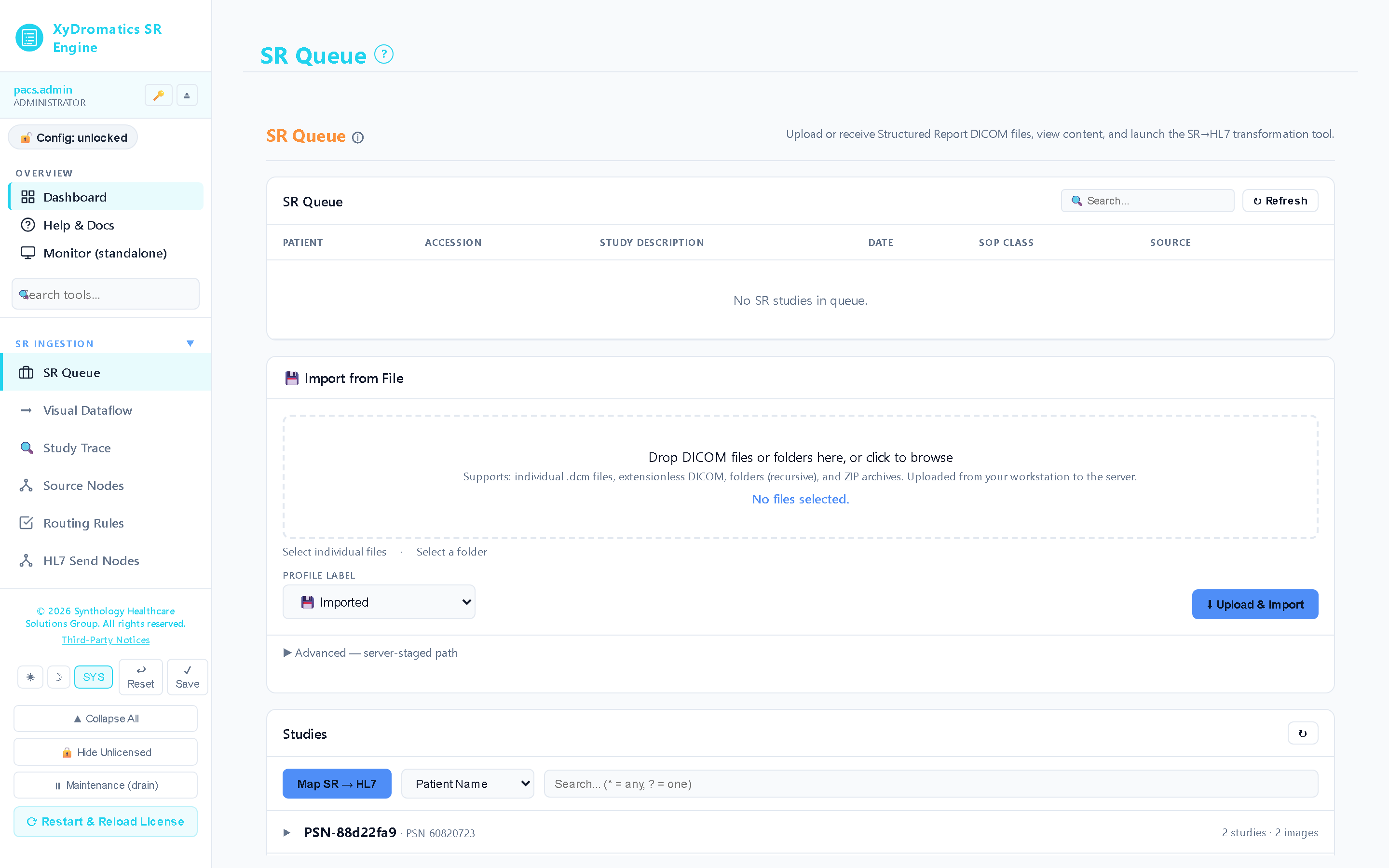
Every structured report as it arrives — view its content, map it to HL7, or launch the SR→HL7 transformation tool. Identifiers masked by role.
A specialized variant of the router-pattern shape — narrower
than the general Router, deeper on SR-specific logic. The
producer / consumer landscape for SR is its own ecosystem
of modalities, AI vendors, dose-tracking platforms, and EMR
targets.
Use cases
Five SR-specific deployment patterns.
Most SR Engine deployments fit one or two of these primary
patterns. Multi-pattern deployments are common in larger
institutions where dose tracking, CAD, and AI findings all
flow through the same SR layer.
Pattern 1
Radiation-dose routing — the institution chooses the destination
Modalities emit Radiation Dose SR (RDSR). What the institution does with it depends on what other systems they have. SR Engine routes to whichever destination(s) match the institutional requirements — without forcing a particular dose-tracking platform.
Flow
1Modality emits RDSR after each study
2SR Engine receives, recognizes the dose-SR SOP class, and selects the modality-scoped SR→HL7 mapping that normalizes vendor quirks on the outbound ORU — the SR object itself is forwarded as authored
3Route depends on institutional setup. Option A: forward to dose-tracking platform (Bayer Radimetrics, Sectra DoseTrack, Siemens teamplay) for full abnormality monitoring + longitudinal tracking
4Option B: forward to Epic Radiant — Epic's Radiology module has integrated dose tracking with ACR DIR submission, automatic RDSR capture, and XR-29 / XR-25 Dose Check alerts. For Epic Radiant institutions, no separate dose-tracking platform is needed
5Option C: direct encrypted submission to ACR Dose Index Registry — for institutions whose requirement is only the registry submission
6Option D: any combination of A / B / C concurrently
7Audit log retains the full chain for regulatory inspection
Pattern 2
SR-to-HL7 ORU translation for EMR integration
Most EMRs (Epic, Cerner, others) want HL7 ORU rather than raw DICOM SR. SR Engine translates SR content into HL7 ORU, so producers (modalities, AI vendors, reporting platforms) can keep emitting SR and the EMR side gets what it expects without the producer having to know which downstream wants what.
Flow
1Producer (modality / AI vendor / reporting platform) emits DICOM SR
2SR Engine receives, recognizes the template
3For DICOM-SR-aware consumers (PACS, dose-tracking platforms): forward SR as-is
4For HL7-only consumers (most EMR-side integrations): SR Engine transforms SR content → HL7 ORU and emits HL7
5Same SR fans out concurrently in different formats to different consumers — producer never has to know
Pattern 3
CAD findings distribution
Mammography CAD, Chest CAD, and other CAD applications produce SR-formatted findings. SR Engine routes those findings to PACS for diagnostic review, to reporting / dictation platforms as template inputs, to EMR via SR-to-HL7 translation where applicable, and to dose-tracking systems where dose-related CAD findings need to be visible.
Flow
1CAD application emits findings as SR (Mammography CAD SR, Chest CAD SR, etc.)
2SR Engine recognizes the CAD SR template
3Per-template routing rules forward to the right downstream destinations
4PACS receives SR for inline radiologist review
5Voice-recognition / dictation platform receives SR as template input for the radiologist's draft report
6EMR receives findings via SR-to-HL7 ORU translation
7Audit captures every CAD finding's routing path
Pattern 4
AI-finding ingestion (with PHI shielding)
AI vendors produce findings as SR. For vendors who don't take BAA scope, SR Engine handles the PHI-shielded round-trip via keyed-hash pseudonymization — same family-wide mechanism as the Router.
Flow
1Outbound: SR Engine de-identifies the source study's SR via keyed-hash pseudonymization, sends to AI vendor
2AI vendor analyzes, returns findings as SR tagged with the same anon-IDs
3SR Engine forwards the returned findings as received — it performs no re-identification
4Findings forwarded to PACS / EMR / reporting platform linked to the correct patient
5AI vendor never received PHI; clinical workflow benefits from the AI findings
Pattern 5
Modality measurement-report distribution
Ultrasound, echo, and other modalities produce SR-formatted measurement reports (TID 5200 cardiac echo, TID 5310 pediatric echo, etc.). SR Engine routes them to PACS, reporting platforms, and CVIS / cardiology PACS where applicable.
Flow
1Modality emits measurement SR alongside the imaging study
2SR Engine recognizes the measurement-SR template
3Routes to: PACS for image-context viewing · reporting platform for template population · CVIS for cardiology workflow
4Per-destination format selection — forward the SR as authored, translate it to an HL7 ORU, or push report tokens to a reporting platform
5Confirmation ACK back to modality where required
Pattern 6
Comprehensive-SR final-report distribution
Modern reporting platforms emit the final radiologist report as a Comprehensive SR object. SR Engine routes the final report to all downstream consumers — PACS, EMR (via SR-to-HL7 translation), referring physician portals, image-sharing platforms.
Flow
1Reporting platform emits Comprehensive SR after report sign-off
2SR Engine routes to PACS for inline report retrieval
3SR-to-HL7 ORU translation for EMR systems that don't consume SR directly
4Optional fan-out to referring physician portal and image-sharing platform
5Audit captures every report's distribution path
Integration points
SR producers, SR consumers, family orchestration.
SR producers (sources)
Modalities emitting RDSR (CT, fluoroscopy, IR, angiography, mammography)
Modalities emitting measurement SR (ultrasound, echo, cardiology)
Voice-recognition / dictation platforms — including the established platforms (Microsoft Nuance PowerScribe, Jacobian M*Modal Fluency for Imaging) and the emerging AI-driven dictation systems (DAX Copilot, Abridge, Nabla, Suki, Heidi, and others entering the market)
AI vendors emitting findings as SR
Reporting platforms emitting Comprehensive SR for final reports
SR consumers (destinations)
PACS / VNA — inline SR retrieval alongside images
Voice-recognition / dictation platforms — established platforms (Microsoft Nuance PowerScribe, Jacobian M*Modal Fluency for Imaging) AND the rapidly-growing AI-driven dictation field (DAX Copilot, Abridge, Nabla, Suki, Heidi, etc.) — SR forwarded as template input for the radiologist's draft report
EMR / EHR — Epic Radiant has integrated dose tracking (ACR DIR submission, automatic RDSR capture, XR-29 / XR-25 Dose Check alerts) — for Epic Radiant institutions this satisfies ACR / state requirements without a separate dose-tracking platform. Cerner via SR-to-HL7 ORU translation
ACR Dose Index Registry — direct encrypted submission supported (no dose-tracking platform required if the only requirement is the registry submission)
XyDromatics Router — Router can forward SR to SR Engine for specialized handling
XyDromatics archive family — SR Engine writes to XyDromatics Repository / Clinical / Clinical Research
XyDromatics Migration Engine — bulk SR migration during PACS replacement
Shared site encryption key for keyed-hash pseudonymization (consistent anon-IDs across products)
Identity, audit, observability
Local accounts with RBAC, plus optional LDAP / Active Directory bind
Active Directory via LDAP bind (server, port, TLS, bind-DN template with group-to-role mapping)
Per-AE-Title audit trail entries
Append-only HIPAA audit log — count-capped ring with archive-before-evict to a durable 6-year store (45 CFR 164.316(b)(2))
Operational metrics via /api/health (consumed by SynthIQ and the SynthGateway engineer console); structured-JSON HIPAA audit trail; rolling plain-text application logs
Availability
Run two, with a standby.
SR Engine has exactly one inbound protocol and it is DICOM, so it is a
straightforward member of a SynthIQ
pool. SynthIQ health-checks each node with both an HTTP call and a
DICOM C-ECHO, routes around one that fails either, and keeps a
study’s SR objects together on one node.
The stronger claim is the engine’s own. Each node holds a
durable, encrypted job queue with an explicit state machine and
per-phase retry, so a downstream archive or HL7 endpoint going away
does not lose work — jobs wait and re-fire. Operators get a
stuck-job surface to inspect, requeue or purge anything that stalls.
One thing worth being precise about: failover protects new
arrivals. A dead node’s queue is local to it and is not migrated
to the standby — it drains when that node comes back.
SR objects are small (typically less than 100 KB each) but
high-volume in dose-tracking and AI-finding deployments.
Sizing reflects SR object count and consumer fan-out, not
full study volume.
Tier
SR volume
CPU
RAM
Storage
Typical site
Small (single facility)
< 1,000 SR / day
2 vCPU
4 GB
100 GB (queue + audit)
Imaging center, single-modality dose-tracking deployment.
Medium (community hospital)
1,000 – 10,000 SR / day
4 vCPU
8 GB
500 GB
Single hospital with full modality mix, CAD deployment, dose tracking.
Large (academic / multi-site)
10,000 – 50,000 SR / day
8 vCPU per node
16 GB per node
1 TB per node
Academic medical center, multi-hospital, multiple AI vendors.
Enterprise (national / IDN)
> 50,000 SR / day
16 vCPU per node
32 GB per node
2 TB per node
Large IDN with enterprise dose tracking + multi-vendor AI.
Licensing
Three packages, à la carte add-ons.
Core handles ingest + basic forwarding. Transform adds
template-aware migration and dose-SR specialization.
Enterprise adds ACR DIR submission. Keyed-hash pseudonymization on
export, and running two or more SR Engines in a SynthIQ pool, ship
with the product rather than a tier.
SR Engine Core
The base package — SR ingest, basic forwarding, audit log. Suited for single-purpose deployments.
C-STORE SCP ingest for DICOM SR; STOW-RS and HL7 MLLP forwarding
Multi-destination STOW-RS fan-out (no destination cap)
Standard SR template recognition
Audit log + dashboard
Web admin UI + RBAC
SR Engine + Transform
Adds template-aware transformation, dose-SR specialization, and CAD-finding routing rules.
Everything in Core
Radiation-dose SR specialization with vendor-specific routing
CAD-finding routing rules
SR-to-HL7 ORU translation
SR Engine Enterprise
Adds ACR DIR submission. Everything else here — including keyed-hash pseudonymization on export and running two or more nodes in a SynthIQ pool — ships with the product.
Everything in Core + Transform
Keyed-hash (HMAC-SHA256) pseudonymization on export, per STOW-RS (DICOMweb) destination — included with the base product. The HL7 ORU and reporting-platform legs are not pseudonymized
ACR Dose Index Registry submission
Run two or more in a SynthIQ pool with a designated standby (included, not tier-gated)
Premium support tier eligible
Per-deployment licensing, not per-SR-object. Multi-product
bundles (SR Engine + Router + archive family) get bundle pricing
and shared site-key provisioning.
Documentation
The controlled-document set.
Current GA release
v1.0.2.211·released 2026-08-04
Every SR Engine deployment ships with the documents below, all managed under SynthQMS document control. The DICOM Conformance Statement is publicly available; the rest are shared under mutual NDA.
What’s new·v1.0.2.211
Report-system integration, config sync, and a queue tag viewer
▸PowerScribe report-system integration — map Structured Report content (measurements, coded concepts, text) onto PowerScribe custom fields over REST or SOAP, with preview and test before you enable delivery.
▸Fleet configuration sync plus config export / import — clone a known-good configuration to another host, or restore a previous one.
▸Read-only DICOM tag viewer for received Structured Reports, right in the queue.
▸Refreshed in-app Help (Analytics, PowerScribe, and Settings pages) and updated End-User and Installation guides.
Document
Title
Notes
DOC-2026-061
Hardware & Software Requirements (SR Engine)
Sizing, OS support, dependencies
DOC-2026-077
DICOM Conformance Statement (SR Engine)
Public — full SOP class + transfer-syntax matrix
DOC-2026-067
EULA Annex (SR Engine)
Annex to the Synthology Master EULA (DOC-2026-063)
DOC-2026-079
Penetration Test Results (SR Engine)
Available under NDA
DOC-2026-092
QA Runner Manual (SR Engine)
Internal QA + customer-validated test runs
DOC-2026-083
User Guide (SR Engine)
Operator + administrator workflows
DOC-2026-072
Installation Guide (SR Engine)
Includes MSI deploy + Linux tarball install
Frequently asked
The questions prospects ask.
Why is this a separate product from the Router?
Two reasons. First: footprint -- many customers (single-purpose dose-tracking deployments, CAD-finding distributors, AI-finding aggregators) need only the SR-specific slice of router-pattern capabilities. Deploying the full Router for them is overkill on cost and on operational surface. Second: specialization -- SR Engine is template-aware in ways that the general Router is not. Treating an RDSR or a Mammography CAD SR as opaque DICOM works, but losing the template awareness loses cross-vendor normalization quality and dose-tracking conformance. SR Engine optimizes for the SR workflow specifically.
Can we run SR Engine alongside the Router?
Yes -- common pattern. Router handles general DICOM routing; SR Engine handles the SR slice with specialized transformation. Router can forward SR objects to SR Engine for specialized handling, then SR Engine fans out to dose-tracking, CAD, reporting, etc. A customer running both gets the platform consistency benefit (shared admin shell, shared audit, shared site encryption key for the keyed-hash pseudonymization).
Do I need a dose-tracking platform like Bayer Radimetrics to use SR Engine?
Often no. SR Engine routes the RDSR; what destination satisfies your requirements depends on what your institution has. Three common shapes: (a) Epic Radiant institutions: Epic's Radiology module has integrated dose tracking, ACR DIR submission, automatic RDSR capture, and XR-29 / XR-25 Dose Check alerts. SR Engine forwards RDSR to Epic Radiant and Epic handles ACR compliance + abnormality alerting -- no separate dose-tracking platform required. (b) Non-Epic-Radiant institutions wanting full dose-abnormality monitoring + longitudinal tracking + QI reports -- you need a dose-tracking platform (Bayer Radimetrics, Sectra DoseTrack, Siemens teamplay), and SR Engine forwards to it. (c) Institutions whose only requirement is ACR Dose Index Registry submission -- SR Engine submits encrypted to the registry directly, no separate platform required. SR Engine's value is the routing flexibility; the analytical / monitoring features themselves live in Epic Radiant or in dedicated dose-tracking platforms, not in SR Engine.
Can SR Engine transform SR into HL7 messages?
Yes. For consumers that want HL7 ORU rather than DICOM SR (common for EMR-side integration), SR Engine transforms the SR content into HL7 ORU and emits HL7 messages. Same for PowerScribe -- SR Engine pushes report tokens to a reporting platform over REST JSON or SOAP XML. The producer does not have to know or care which destination expects which format; SR Engine handles the per-destination shape.
Can SR Engine send SR to voice-recognition / dictation platforms?
Yes. Voice-recognition / dictation platforms take SR content as template inputs to populate the radiologist's draft report. This includes the established platforms (Microsoft Nuance PowerScribe, Jacobian M*Modal Fluency for Imaging) and the rapidly-expanding field of AI-driven dictation systems (DAX Copilot, Abridge, Nabla, Suki, Heidi, and a steady stream of new entrants). SR Engine routes to whichever platform(s) the institution uses, alongside the other consumer destinations. A single RDSR or measurement SR can land in the dictation platform (template input) AND the dose-tracking platform (compliance) AND the PACS (image-context retrieval) simultaneously. The dictation-platform landscape is moving fast; SR Engine's job is to keep routing to whatever the institution picks without constraining the choice.
What does SR Engine NOT do?
SR Engine is a routing and format-translation engine. It does NOT track dose abnormalities, does NOT do longitudinal dose tracking per patient, does NOT generate QI / radiation-safety reports, does NOT do clinical decision support on SR content. Those are the analytical / monitoring features that dose-tracking platforms (Bayer Radimetrics, Sectra DoseTrack, Siemens teamplay) or EMR-native dose-tracking (Epic) provide. SR Engine's job is making sure the right SR content gets to the right destination in the right format.
How does SR Engine handle older SR templates from legacy modalities?
Template-version migration is a core capability. Older modality firmware emits older versions of TID 1500, TID 5200, and other templates; current consumers expect newer versions. SR Engine recognizes the source template version and migrates forward to the consumer-expected version, preserving the measurement / finding semantics. The transformation is audit-trailed.
Can SR Engine produce SR for systems that don't natively emit it?
No -- SR Engine is an ingest / transform / forward engine, not an SR-creation tool. If your reporting platform produces free-text reports rather than SR, the place to address that is the reporting platform itself or the integration layer between reporting and PACS. SR Engine handles the routing and transformation of SR objects that already exist somewhere in the workflow.
How does the AI-vendor PHI-shielding workflow work here?
Same family-wide mechanism as the Router and the archive siblings. SR Engine uses keyed-hash pseudonymization on the way out (to the AI vendor). The re-identification envelope travels inside the exported object; SR Engine itself performs only the one-way outbound leg, and identity is restored by the product that receives on the way back. AI vendor sees only anon-IDs; findings get linked to the right patient. A multi-product customer's site encryption key is shared, so anon-IDs from SR Engine are consistent with anon-IDs from the Router or XyDromatics Migration in the same deployment.
What's the regulatory classification?
Non-device software under FD&C Act §520(o)(1)(D), the 21st Century Cures Act §3060 carve-out for software that transfers, stores, converts, or displays device data without interpreting or analyzing it. Same framework as Router, XyDromatics Repository, and XyDromatics Migration -- SR Engine handles storage and forwarding of SR objects without modifying clinical interpretation. Tag transformations are constrained to non-interpretive scope (template migration, anonymization, normalization).
Is SR Engine cross-platform?
Yes -- Windows and Linux, same as the rest of the router-pattern family. MSI installer for Windows, self-contained Linux tarball for Linux. Both supported equally.
Talk through your SR workflow.
Dose tracking? CAD findings? AI-finding distribution?
Comprehensive-SR final reports? Tell us the SR-specific
workflow you’re building and we’ll come back
within one business day with a proposed architecture.