XyDromatics™ Migration Engine —
vendor-agnostic by design.
The right-sized migration appliance — and the universal
pre-processor for any migration project. Use it standalone
for small / medium migrations, in front of
XyDromatics Migration
for large engagements, or as a normalization + tag-coercion
layer in front of third-party migration tools (DataFirst,
Laurel Bridge, DicomSys, or a customer’s incumbent
platform). Migration Engine doesn’t care who’s
doing the actual migration delivery.
Cheap, parallelizable edge work — for any migration target.
Migration Engine focuses on the syntactic cleanup that makes
downstream verification, transformation, and audit faster —
regardless of who’s doing the downstream work.
Multi-source ingestion
Read from any DICOM-conformant source, plus filesystem and HL7-driven inputs. Same source-system breadth as XyDromatics Migration in a smaller footprint.
C-STORE SCU (push from source) + SCP (pull-style ingest)
Q/R against the source archive (C-FIND + C-MOVE / C-GET)
STOW-RS for modern HTTP-based source systems
MWL / Q-R / pass-through proxy listeners — relay a modality's C-FIND or MWL query to an upstream node
Normalization at the edge
The cheap, parallelizable cleanup work that makes downstream verification + audit faster. Run multiple Migration Engine workers; let downstream tools focus on their actual jobs.
Malformed-header repair (legacy systems wrote non-spec data)
Deprecated VR (Value Representation) coercion
Non-spec timestamp formatting normalized to spec-compliant
SOP Instance UID validation + remediation where possible
Vendor-quirk handling through conditional rules — gate a coercion rule on the sender's own tags (Manufacturer, ManufacturerModelName) so a known quirk is corrected automatically wherever it appears
Tag coercion
Force common tag values into the formats downstream systems expect — without changing the value semantics. Distinct from XyDromatics Migration's audit-heavy tag transformation.
Accession-number padding / formatting per institutional standard
Date-string format normalization (YYYYMMDD vs ISO-8601)
AE-Title remapping (legacy modality AE-Titles -> current naming convention)
Patient-name format coercion (e.g., FAMILY^GIVEN canonicalization)
Study Description and BodyPartExamined remapping via tag-morph set and regex rules (free-text; no bundled code system)
Configurable coercion rules per source / per modality
Resilient forwarding + operator pacing
A standalone migration appliance has to manage its own pacing. Operator-controlled start/pause, retry policies, and dead-letter handling.
Operator-controlled migration windows — manual start with live pause/resume, so large moves run off-peak
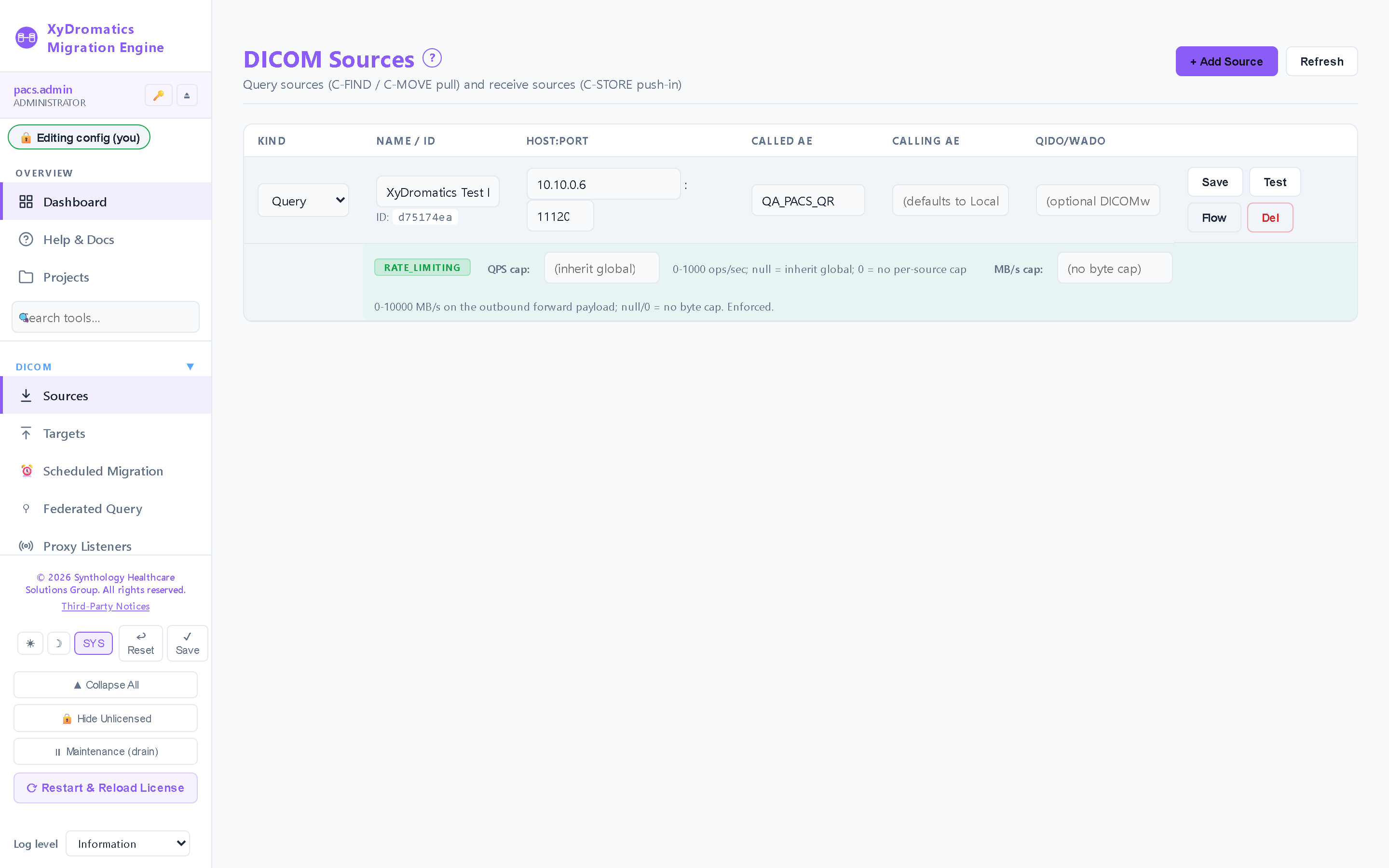
Bandwidth and request-rate caps on the outbound leg — a global MB/s and queries-per-second ceiling, with a per-source override so one fragile legacy PACS can be throttled independently of the rest
Deterministic FIFO study queue — a failed study is deferred by its own backoff window rather than starving behind the rest of the batch
Exponential-backoff retry with configurable policy
Dead-letter queue for persistently-failing sends
Pause / resume with state checkpointing
Concurrent worker support for parallel sends
Universal pre-processor (vendor-agnostic)
Migration Engine doesn't care who's doing the actual migration delivery. Normalize and coerce upstream of any target platform — Synthology or third-party.
Front-end for XyDromatics Migration (packaged pattern for large engagements)
Front-end for DataFirst engagements (via IES-Advisors)
Front-end for Laurel Bridge migration tools (Compass, Navigator)
Front-end for DicomSys migration tools (UVR)
Front-end for customer's existing migration platform (any DICOM-conformant target)
Standalone — no downstream migration platform required when Migration Engine handles the full move
Family-platform features
Same platform features as the rest of the router-pattern family.
Support-role PHI masking under the per-customer site key — patient identifiers shown to the read-only support role render as deterministic PSN- tokens rather than raw PHI. Migration Engine forwards studies as authored; it does not pseudonymize on export
Outbound keyed-hash pseudonymization; restoring identity on a returning study is the Router's role, not Migration Engine's
Web administration UI with shared sidebar shell
Role-based access control with full permission catalog
Append-only migration event log + per-tag transform audit (before → after), sealed at rest with SQLCipher
21 CFR Part 11-aligned audit trail
See it
Bulk migration, on screen.
Live captures from a running installation — click any screen to enlarge it.
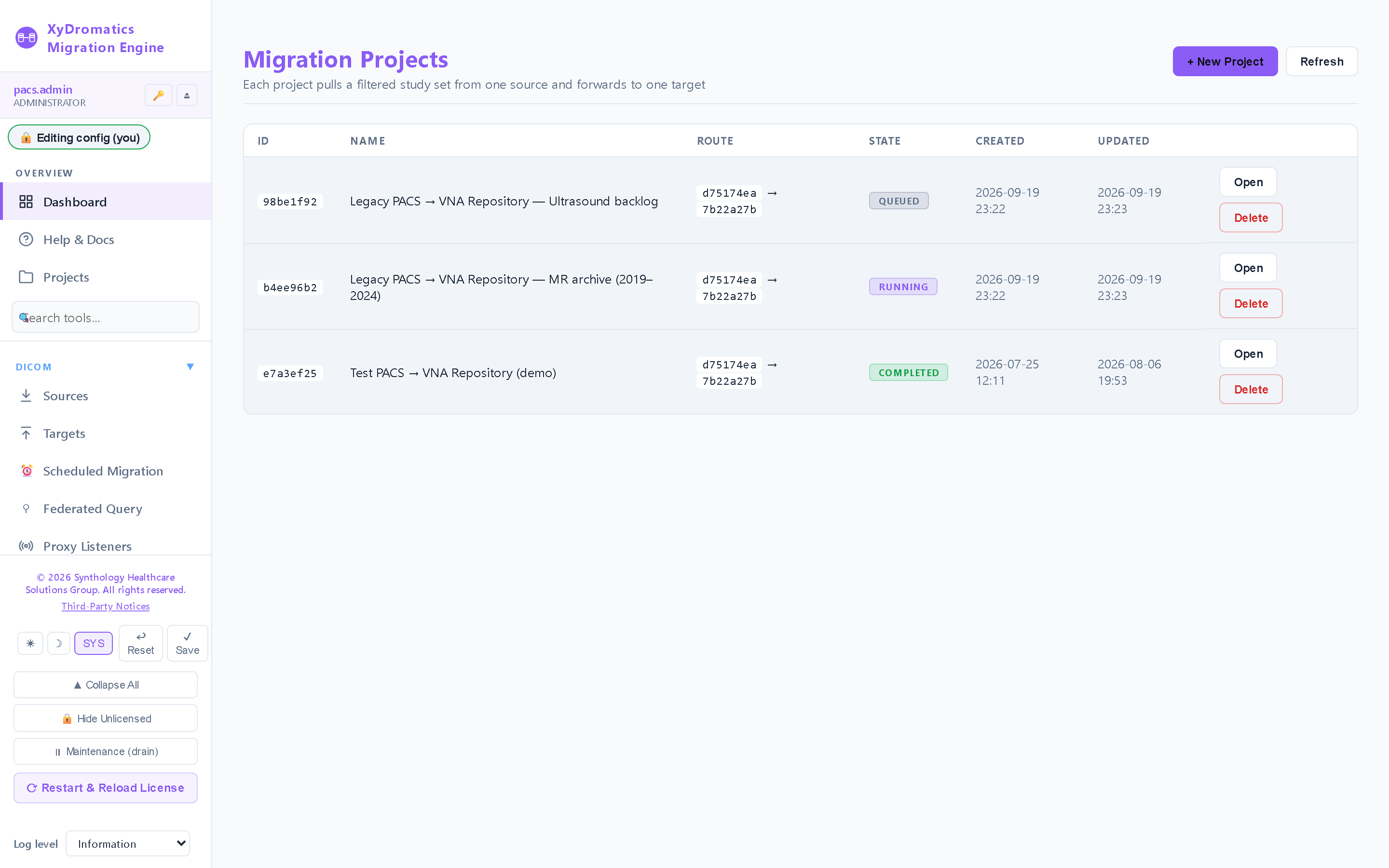
01
Migration projects
Source → target projects with scope, state and progress — queued, running and completed side by side.
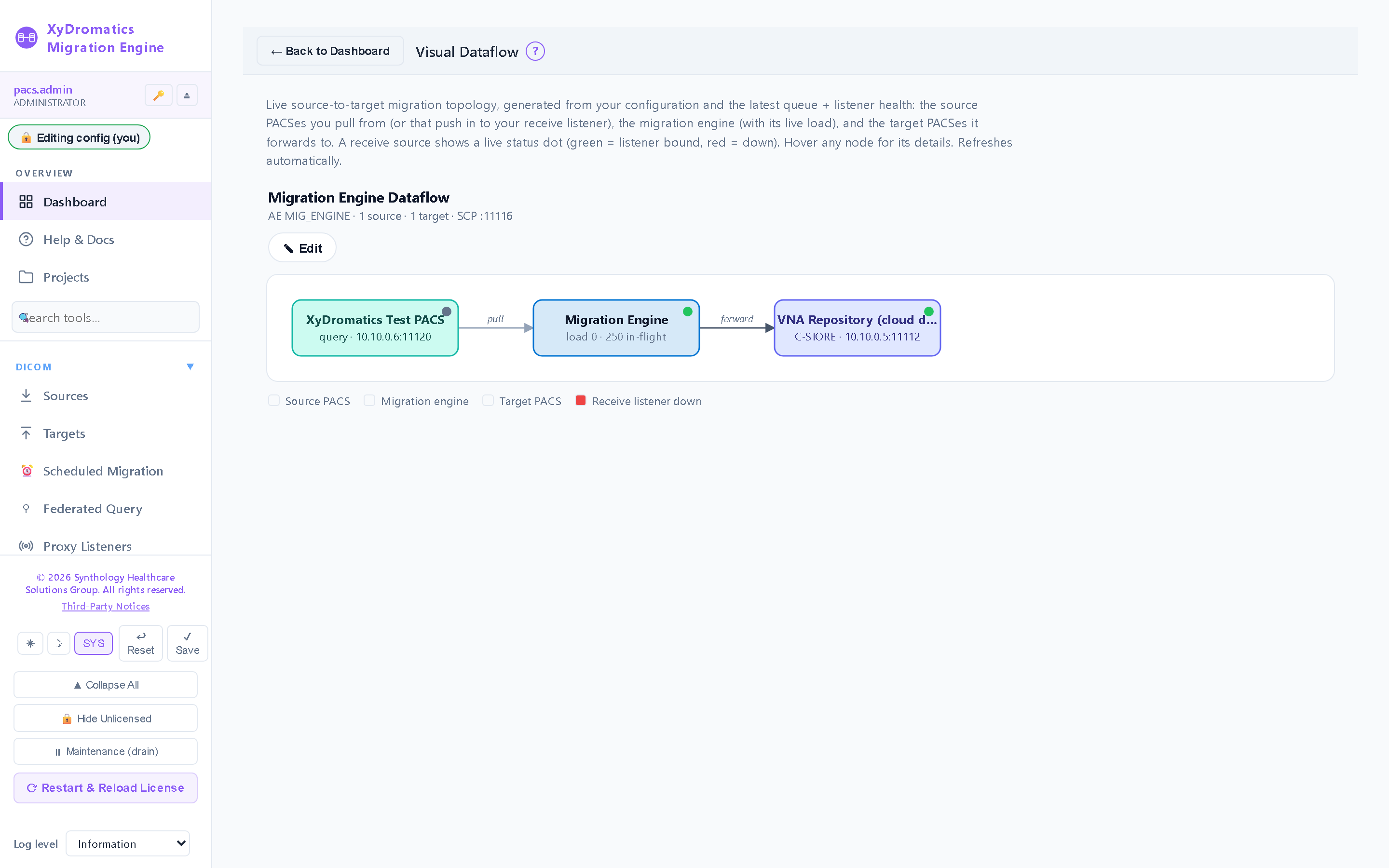
Source · Migration Engine · any downstream target.
The architectural shape is deliberately flexible — Migration
Engine sits between source and target, and the target can be
any migration platform (Synthology, third-party, customer-
incumbent) or a final archive directly.
Deployment patterns
Six deployment shapes.
Customers use Migration Engine in multiple complementary
patterns. Standalone for small projects, front-end for XyDromatics
Migration on large engagements, front-end for third-party
tools where the customer has an incumbent platform, modality-
side cleanup as a permanent fix.
Pattern 1
Standalone small / medium migration
A bounded migration project — single source PACS, one or two target archives, weeks-to-months runway. Migration Engine handles the full move: read source, normalize, coerce, send to target. No need for the multi-petabyte XyDromatics Migration heavyweight.
Flow
1Source: legacy PACS via Q/R or filesystem export
2Migration Engine ingests with normalization + coercion at the edge
3Per-source / per-modality cleanup rules applied
4Studies forwarded to target archive (any DICOM-conformant)
5Append-only HIPAA audit log — count-capped ring with archive-before-evict to a durable 6-year store — plus a completion report at engagement end
Pattern 2
Front-end for XyDromatics Migration
Large multi-petabyte migrations benefit from horizontal pre-processing. Multiple Migration Engine workers normalize + coerce in parallel; clean data flows into XyDromatics Migration which focuses on per-study verification, full tag transformation, and hash-chain audit.
Flow
1Multiple Migration Engine workers deployed in parallel
2Each worker reads a partition of the source archive
3Normalization + coercion happens at the edge (cheap, parallel)
4Clean data flows to XyDromatics Migration for verification + audit + transformation
5XyDromatics Migration writes to the final target with full audit trail
6Net effect: meaningfully higher overall throughput vs XyDromatics Migration alone
Pattern 3
Front-end for DataFirst (via IES-Advisors)
IES-Advisors engagements using DataFirst as the migration platform can layer Migration Engine in front to handle the syntactic cleanup that DataFirst doesn't natively do — character sets, malformed headers, deprecated VRs. Migration Engine cleans; DataFirst delivers.
Flow
1IES-Advisors scoped engagement using DataFirst as the migration platform
2Migration Engine deployed as front-end pre-processor
3Source data flows through Migration Engine first
4Normalized, tag-coerced data flows into DataFirst
5DataFirst handles deduplication and cross-vendor consolidation against clean input
6Customer benefits from improved throughput without changing the DataFirst engagement shape
Pattern 4
Front-end for Laurel Bridge / DicomSys / third-party migration tools
Customer has an existing migration tool (Laurel Bridge Compass, DicomSys UVR, or another vendor's platform) and wants to add Migration Engine as a normalization + coercion layer to improve migration throughput and reduce retry / quarantine volume on their existing tool.
Flow
1Existing migration tool already deployed at customer site
2Migration Engine inserted upstream as the pre-processor
3Source data normalized and coerced before reaching the existing tool
4Existing tool sees cleaner data, fewer retries, less quarantine queue volume
5Customer keeps their incumbent migration platform investment
6Migration Engine licensable standalone — no other Synthology products required
Pattern 5
Modality-side cleanup pre-PACS
A single modality (or a small group) emits chronically malformed DICOM that downstream PACS struggles with. Migration Engine sits in front of the PACS as a permanent cleanup layer — turning bad-data emission into an architecture problem rather than a daily ops headache.
Flow
1Modality emits DICOM with vendor-specific quirks
2Migration Engine ingests, normalizes, coerces
3Clean DICOM forwarded to PACS / VNA
4PACS receives reliable data; ops team stops fielding daily "this study won't open" tickets
5Vendor-specific quirk profile maintained by Migration Engine, not by every downstream system
Pattern 6
AI-vendor integration without sharing PHI
Same family-wide round-trip pattern as the Router and the archive siblings. Migration Engine de-identifies via keyed-hash on the way out, AI vendor analyzes anonymized data, findings come back, Migration Engine re-identifies and routes findings to the correct downstream destination.
Flow
1Source study qualifies for AI analysis
2Migration Engine de-identifies via keyed-hash pseudonymization
3De-identified study sent to AI vendor (vendor sees only anon-ID)
4AI vendor returns findings tagged with the anon-ID
5Migration Engine re-identifies via the retained mapping
6Findings forwarded to PACS / EMR linked to the correct patient
Integration points
Sources, Synthology targets, third-party targets.
Migration Engine’s third-party-target list is what
makes it vendor-agnostic. Customers running an incumbent
migration platform don’t have to choose between
replacing it and skipping the cleanup benefits — Migration
Engine slots in upstream of any DICOM-conformant target.
Shared site encryption key (consistent anon-IDs across the customer's portfolio)
Shared admin shell (consistent operational surface across products)
Shared audit-trail format (cross-product audit aggregation)
SynthQMS integration for migration-plan change control
Identity, audit, observability
Local accounts with RBAC, plus optional LDAP / Active Directory bind
Active Directory via LDAP bind (server, port, TLS, bind-DN template with group-to-role mapping)
Per-AE-Title audit trail entries
Append-only HIPAA audit log — count-capped ring with archive-before-evict to a durable 6-year store (45 CFR 164.316(b)(2))
Serilog console and rolling-file logs, a structured-JSON HIPAA audit log, and operational metrics on /api/health
Migration-progress webhook (bearer-authenticated) for external run tracking
Availability
A run that survives interruption.
A migration is a long-running batch with a defined end, so availability
here means the run survives being interrupted — not that traffic
reroutes somewhere else. Pool failover is the wrong mechanism for this
product, and we do not offer it.
Every study is a durable row in the engine’s encrypted job
database with its own state, attempt count and retry gate. If the
service is stopped, restarted, or crashes mid-study, anything in flight
is automatically returned to the queue at startup and picked up again
— the backlog is never lost. Transient target failures back off
and retry rather than failing the study outright.
That makes a migration schedulable around your constraints: pause a
run, patch the host, restart, resume. A graceful stop finishes
in-flight studies and declines new inbound associations transiently, so
the source PACS simply retries.
Migration Engine workers scale linearly until source-side
throttling becomes the bottleneck. Add workers; throughput
adds. Sizing is per-worker.
Tier
Workload
CPU
RAM
Notes
Worker (single)
1 – 5 TB / day throughput
4 vCPU
8 GB
Standalone single-site migration. Modality-side cleanup. Single front-end worker for medium XyDromatics Migration engagements.
Worker pair (2 workers)
5 – 15 TB / day aggregate
4 vCPU per worker
8 GB per worker
Larger standalone migrations, or 2-worker front-end for XyDromatics Migration / third-party tools.
Worker cluster (4+ workers)
15+ TB / day aggregate
8 vCPU per worker
16 GB per worker
Multi-petabyte migrations as XyDromatics Migration front-end, or large-scale standalone consolidation.
Licensing
Three packages, project-scoped or perpetual.
Migration Engine licensing fits both project shapes:
short-engagement migrations (project-scoped) and ongoing
modality-cleanup deployments (perpetual). Tier choice
depends on the breadth of coercion needs and whether
AI-vendor PHI shielding is required.
Migration Engine Core
The base appliance — multi-source ingest, normalization, basic forwarding. Suited for standalone small / medium migrations.
Append-only HIPAA audit log — count-capped ring with archive-before-evict to a durable 6-year store (45 CFR 164.316(b)(2))
Cross-product site-key sharing (with Router / archive family / SR Engine)
Unlimited migration capacity
Premium support tier eligible
Project-scoped licensing for short-engagement migrations;
perpetual licensing for ongoing modality-cleanup deployments.
Multi-product bundles (Migration Engine + XyDromatics Migration, or
Migration Engine + Router + archive family) get bundle pricing and
shared site-key provisioning.
Documentation
The controlled-document set.
Current GA release
v1.0.3.179·released 2026-08-07
Every Migration Engine deployment ships with the documents below, all managed under SynthQMS document control. The DICOM Conformance Statement is publicly available; the rest are shared under mutual NDA.
What’s new·v1.0.3.179
Scheduled Migration — keep a source and target continuously in sync
▸New Scheduled Migration — set a cron schedule and the engine automatically re-discovers new studies at the source and enqueues them for migration, so an ongoing migration stays current without manual re-runs.
▸Previously-failed or partial transfers are retried on each scheduled cycle, so a transient target outage recovers on the next run.
▸Schedule filters are non-PHI (modality and date window), and studies already migrated are never re-copied.
▸More reliable project completion — a concurrent resume can no longer strand queued work in a project that is finalizing.
▸Ships with the approved End-User License Agreement and clears a full QA + security-test pass on the release build.
Annex to the Synthology Master EULA (DOC-2026-063)
DOC-2026-098
Penetration Test Results (Migration Engine)
Available under NDA
DOC-2026-108
QA Runner Manual (Migration Engine)
Internal QA + customer-validated test runs
DOC-2026-105
User Guide (Migration Engine)
Operator + administrator workflows
DOC-2026-104
Installation Guide (Migration Engine)
Includes MSI deploy + Linux tarball + multi-worker pattern
Additional documents
Migration Engine-specific documents beyond the standard set. Items
marked Pending are tracked for
authoring under SynthQMS change control.
Document
Title
Notes
DOC-2026-400
Vendor-Quirk Profile Catalog (Migration Engine)
Known vendor quirks and the coercion rules that correct them, maintained as living documentation
Frequently asked
The questions prospects ask.
How is Migration Engine different from XyDromatics Migration?
Different scale and different shape -- but they're often deployed together. Migration Engine is the smaller-footprint appliance: standalone for small / medium migrations, or as a horizontal pre-processor in front of XyDromatics Migration on large engagements. XyDromatics Migration is the multi-petabyte workhorse with full HA, parallel worker nodes, multi-month migration plans, full per-study verification, transformation, and hash-chain audit. Same family, complementary roles.
Does Migration Engine require XyDromatics Migration or any other Synthology product?
No. Migration Engine is fully standalone-licensable. Many customers buy it on its own for small / medium migration projects, modality-side cleanup, or as a pre-processor for their existing third-party migration platform (DataFirst, Laurel Bridge, DicomSys, etc.). No other Synthology product required. If the customer later adds Router / archive family / SR Engine, the products inherit the same site encryption key for cross-product anon-ID consistency.
Can Migration Engine work with non-Synthology migration platforms?
Yes -- this is one of its core value propositions. Migration Engine doesn't care who's doing the actual migration delivery. Insert it upstream of DataFirst (via IES-Advisors), Laurel Bridge Compass / Navigator, DicomSys UVR, or any customer-incumbent migration platform. Migration Engine normalizes character sets and malformed headers, coerces common tag misalignments, and hands clean data to whatever platform is doing the actual move. Net effect: higher throughput, fewer retries, less quarantine queue volume on the downstream platform -- without disturbing an existing investment.
What's the difference between coercion and transformation?
Coercion forces values into expected formats without changing their semantic meaning -- accession-number padding, date-string format normalization, AE-Title remapping. It's cheap, parallelizable edge work. Transformation (which lives in XyDromatics Migration, not here) changes values semantically per a documented audit-trailed rule -- e.g., re-mapping a study description from a source institutional code to a target institutional code per a migration plan. Migration Engine handles coercion; downstream systems handle transformation.
Does Migration Engine take part in the AI-vendor PHI-shielding workflow?
No — and it is worth being direct about that, because the rest of the family does. Migration Engine has no export pseudonymization at any scope: it forwards studies as authored, and it reports that fact about itself in its own health telemetry. Put the Router (or SR Engine, for reports) on the leg that faces the AI vendor — those products carry the keyed-hash pseudonymization and, in the Router's case, the gated re-identification. What Migration Engine does carry is support-role PHI masking: identifiers shown to the read-only support role render as deterministic PSN- tokens under the same per-customer site key.
How is Migration Engine deployed alongside an existing third-party migration tool?
Insert upstream. The third-party tool keeps its own configured source connections, workflow, and target. Migration Engine becomes a new "source" for the third-party tool -- but with pre-cleaned data that flows through normalization and coercion before the third-party tool sees it. The customer's migration plan, project schedule, and stakeholder reporting don't change; Migration Engine improves the throughput transparently.
What's the regulatory classification?
Non-device software under FD&C Act §520(o)(1)(D), the 21st Century Cures Act §3060 carve-out for software that transfers, stores, converts, or displays device data without interpreting or analyzing it. Same framework as Router, XyDromatics Repository, XyDromatics Migration, and SR Engine -- Migration Engine handles storage and forwarding without modifying clinical interpretation. Coercion is constrained to syntactic / format-level changes; semantic value changes are out of scope (those belong in XyDromatics Migration).
Is Migration Engine cross-platform?
Yes -- Windows and Linux, same as the rest of the router-pattern family. MSI installer for Windows, self-contained Linux tarball for Linux. Multi-worker deployments can mix OS platforms.
Talk through your migration cleanup needs.
Standalone migration? Front-end for XyDromatics Migration? Cleanup
layer for an existing third-party migration tool? Modality-
side cleanup that’s become a daily ops headache? Tell
us the shape and we’ll come back within one business
day with a proposed deployment.