Drop-in replacement for F5, NetScaler, or HAProxy in front of
any PACS or DICOM Router pool. Routes by Study Instance UID,
not TCP 5-tuple. Keeps every study together on one backend —
within an association, across separate associations and late
re-sends, and across SynthIQ restarts.
Vendor-neutral by design. Works with any
DICOM-conformant backend — Synthology fleet, vendor PACS
(GE, Siemens, Philips, Fujifilm, Sectra, Visage), research
VNAs, cloud-native DICOM endpoints. Heterogeneous pools are a
first-class deployment shape — every backend gets in, graded by
how much load it can report. Three doors, no dead ends.
A modality sends a 1,500-instance CT study to your PACS pool's
VIP. The L4 load balancer hashes the TCP 5-tuple and scatters
the instances across two, three, or all five backends. The
Study Instance UID — the thing that makes those 1,500 instances
one exam — is invisible to the LB.
Now no single backend holds the whole exam — each node has a
fragment. When that study later has to be re-sent, or forwarded
to a second destination (an AI vendor, a VNA, a downstream
archive), every node re-transmits its fragment, so the
destination receives overlapping, duplicated instances. Per-node
counts disagree because each device only ever saw part of the
study. There is no single device that is the study's source of
truth.
With SynthIQ in front
SynthIQ parses each C-STORE far enough to read the Study
Instance UID, then routes it to the same backend that holds
(or will hold) the rest of the study. The binding is
persistent — every instance of that study lands on the same
backend, even ones that arrive in a later association, as a
delayed re-send, or after a SynthIQ restart. (Affinity keys on
the Study Instance UID alone — SynthIQ groups the instances of
one study, not a patient's separate exams, and stores no MRN.)
Result: one backend is the whole study's single source of truth.
A re-send, or a forward to an additional destination, happens
once — from that one device — so there are no duplicate fragments
arriving from multiple nodes. Per-node counts reconcile because
each study lives whole on one node. And SynthIQ never caches the
pixels: every object streams through and is forwarded; only the
routing record (which study went to which backend) is kept.
Want the full analysis?
Read the comprehensive whitepaper — covers the problem in depth, the design, operational characteristics, regulatory posture, and an honest comparison against F5, NetScaler, HAProxy, Mirth Connect, Forcare, and vendor-PACS internal LBs.
Capabilities
What SynthIQ actually does.
Study-affinity routing (the core)
The capability no generic L4 load balancer can offer.
Reads Study Instance UID from every incoming C-STORE — knows what study each instance belongs to
Persistent affinity cache binds each SUID to a specific backend on first sight
Every subsequent instance of the same study (same Study Instance UID) routes to the same backend — within an association, across separate associations, late re-sends hours or days later, and across SynthIQ restarts
Affinity survives SynthIQ restarts and process crashes (state in SQLite, PostgreSQL, or SQL Server)
Honors affinity even if the bound backend is currently slow — the study's earlier instances live there, so the study stays coherent
Routes new studies based on actual backend load, not blind hashing.
Polls each backend's health endpoint every 5 seconds (configurable)
Tracks each backend processing-queue depth and weighted load score from its health endpoint
Routes new studies to the lowest-queue healthy backend — no piling onto saturated nodes
Backends that miss heartbeats drop out of new-study candidate selection
Affinity-bound studies still attempt their bound backend — that's where the priors are
Vendor-neutral by design
Works with any DICOM-conformant backend. Not just for the Synthology fleet.
Drop-in replacement for F5 BIG-IP, NetScaler ADC, HAProxy, AWS NLB — wherever you have a generic L4 LB in front of a DICOM pool
Heterogeneous pools supported: SynthIQ can front a mixed pool of vendor PACS, Router instances, third-party DICOM endpoints
No proprietary protocol — every backend conversation is plain DICOM via fo-dicom's standard SCU
Modalities continue to use their existing AE-title + IP config — SynthIQ presents one VIP per pool
Plain DICOM on the wire, inbound and outbound — DICOM PS3.15 Secure Transport is reserved for a future release, so deploy on a trusted network segment
Inspectable operations
Open admin UI, open state. Your ops team can see what SynthIQ is doing.
Admin SPA — dashboard, pool and backend-node CRUD, settings (auth, email, LDAP, disk monitor, watermarks) and role management, all RBAC-gated
Affinity bindings are inspectable in the admin UI Study-Affinity Cache browser and via /api/affinity; the default SQLite store is SQLCipher-encrypted at rest
Routing decisions color-coded in the UI: indigo (affinity hit), green (least busy), yellow (cached association), red (fallback)
Every routing decision emits one structured log line — Serilog rolling file + console
Custody surface: query whether a backend has confirmed durable storage of a study, by UID (HTTP; not the DICOM Storage Commitment SOP class)
Vendor-neutral pools
Three doors, no dead ends.
SynthIQ fronts a mixed pool of any DICOM-conformant
backend — your existing PACS, an XyDromatics Router, a research
VNA, a cloud endpoint, an AI vendor. How smart the balancing gets
on a given backend depends on one thing: how much load that
backend can tell us. SynthIQ grades each by load-signal fidelity —
and never balances a backend on a number it didn't
report.
1
Native
Synthology products
Full /api/health — queue depths, load score, associations, disk headroom, throughput.
Richest least-busy, ready for predictive weighting.
2
Certified
Any vendor · self-service
Implements the published SynthIQ Health Contract — one lightweight endpoint returning status, load, and capacity.
Real least-busy — native-grade on the essentials.
3
Adapter
Any vendor · we do the work
Exposes its own existing health/metrics in its own format; SynthIQ normalizes them onto a common load scale.
Real least-busy via a per-vendor shim — zero vendor effort.
4
Liveness
Any node with a health URL
No parseable load — an up/down check only: an HTTP(S) probe of the backend's health URL each heartbeat, plus a DICOM C-ECHO that confirms the listener is actually accepting associations.
Weighted distribution, gated by the probe — never least-busy.
Three doors for any vendor
A third-party backend joins a SynthIQ pool one of three ways:
implement the published Health Contract (one
small endpoint, self-service certification), let us
adapt your existing metrics, or run
heartbeat-only. None of them is a dead end — a
backend that can only say “I'm alive” still earns reliable
failover and weighted distribution. Nothing is excluded; nothing
is faked.
The safety principle
A node enters least-busy ranking only when its load is
genuinely known. A heartbeat-only node has an unknown
load — so SynthIQ distributes to it by weight and watches it with
an up/down probe, rather than treating “no signal” as “empty”
and flooding it. We never flood a backend we can't
measure.
Why it displaces a generic L4 balancer
On the imaging path
F5 / NetScaler / HAProxy / NLB
SynthIQ
Unit of routing
TCP connection (5-tuple hash)
DICOM study (Study Instance UID)
Study coherence
Split across backends
Kept whole on one backend
Health signal
TCP-open / HTTP-200
DICOM ingest-queue depth + heartbeat
Least-busy basis
Connection count / hash
Real reported backend load
A silent backend
Looks healthy → gets flooded
Balanced by weight → never falsely “least-busy”
Mixed-vendor pool
Blind — every node looks alike
Graded by load-signal fidelity
Footprint
Appliance / cloud-LB license
A single software binary
Lock-in
Single-vendor balancer
One control point for a whole mixed-vendor estate
Keep your F5 or NetScaler for the rest of your traffic — SynthIQ
owns the DICOM path, where a connection-level balancer is blind to
the study. One control point replaces both the scatter problem and
the single-vendor balancer's lock-in across a whole mixed-vendor
imaging estate.
What ships today.
Study affinity, health-aware least-busy, weighted distribution, the
drop-in L4 replacement, the published SynthIQ Health Contract
with self-service SynthIQ-Ready certification, the
DICOM C-ECHO listener verification that rides on every heartbeat, and the
never-balance-on-a-number-you-didn't-report safety rule are all
available now. The one path we build on demand is the
per-vendor Adapter — normalizing a vendor's existing metrics
onto our load scale — added when a specific integration calls for it.
Watch it
One modality. Two routers. No single point of failure.
A modality sends to SynthIQ. SynthIQ balances every study across two XyDromatics Routers by study affinity. Both routers deliver to the archive — while you watch.
Modality→
SynthIQ→
Router-A + Router-B→
Archive
Four live consoles, one batch of studies. Identifiers are shown exactly as a masked-role operator sees them.
See it
One AE title, many applications — on screen.
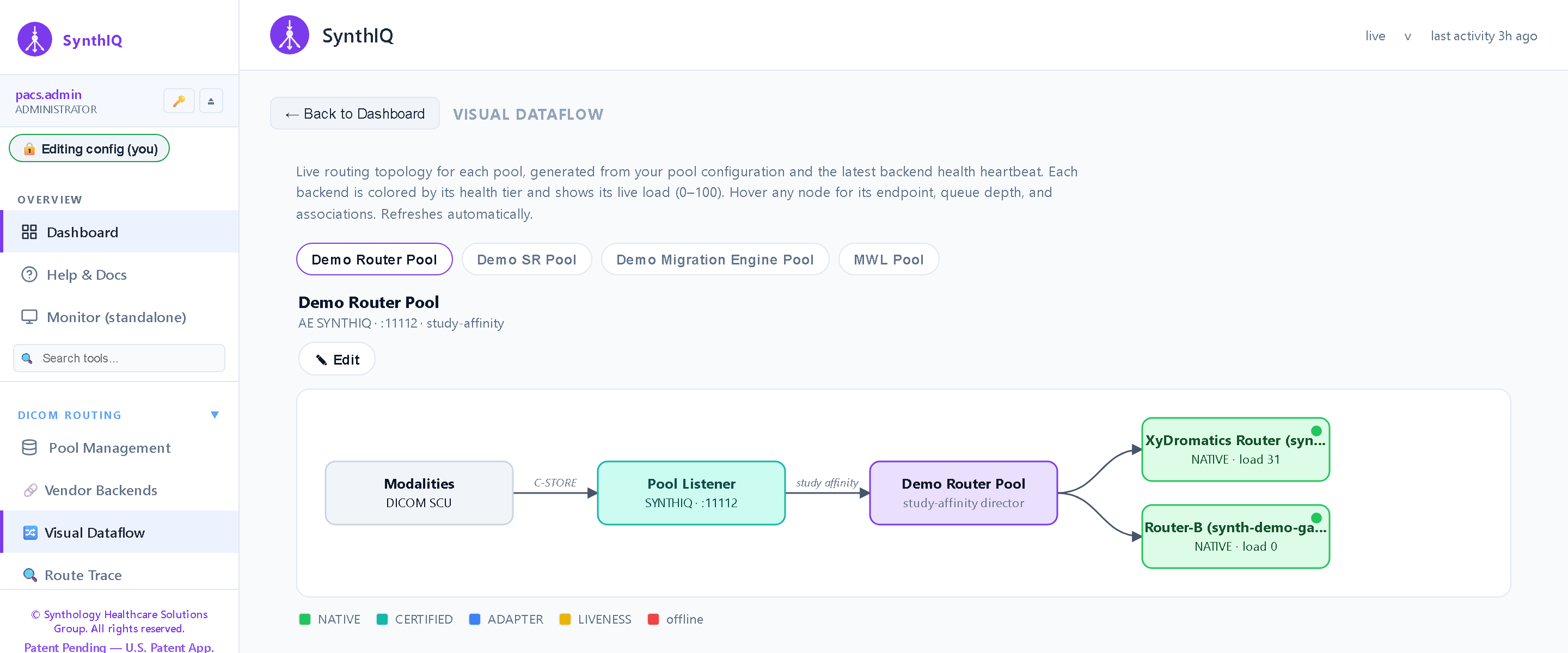
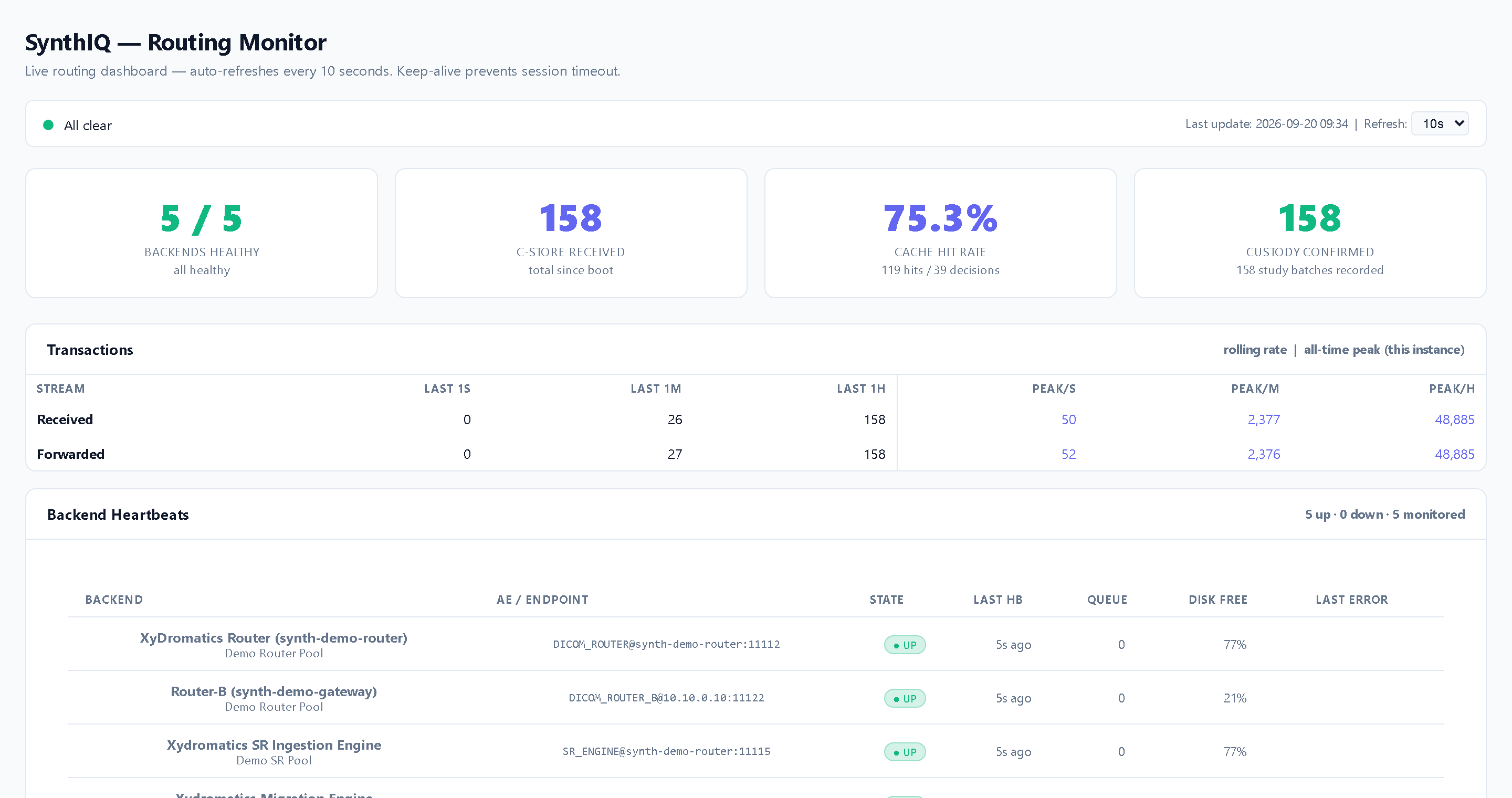
Live captures from a running installation — click any screen to enlarge it.
01
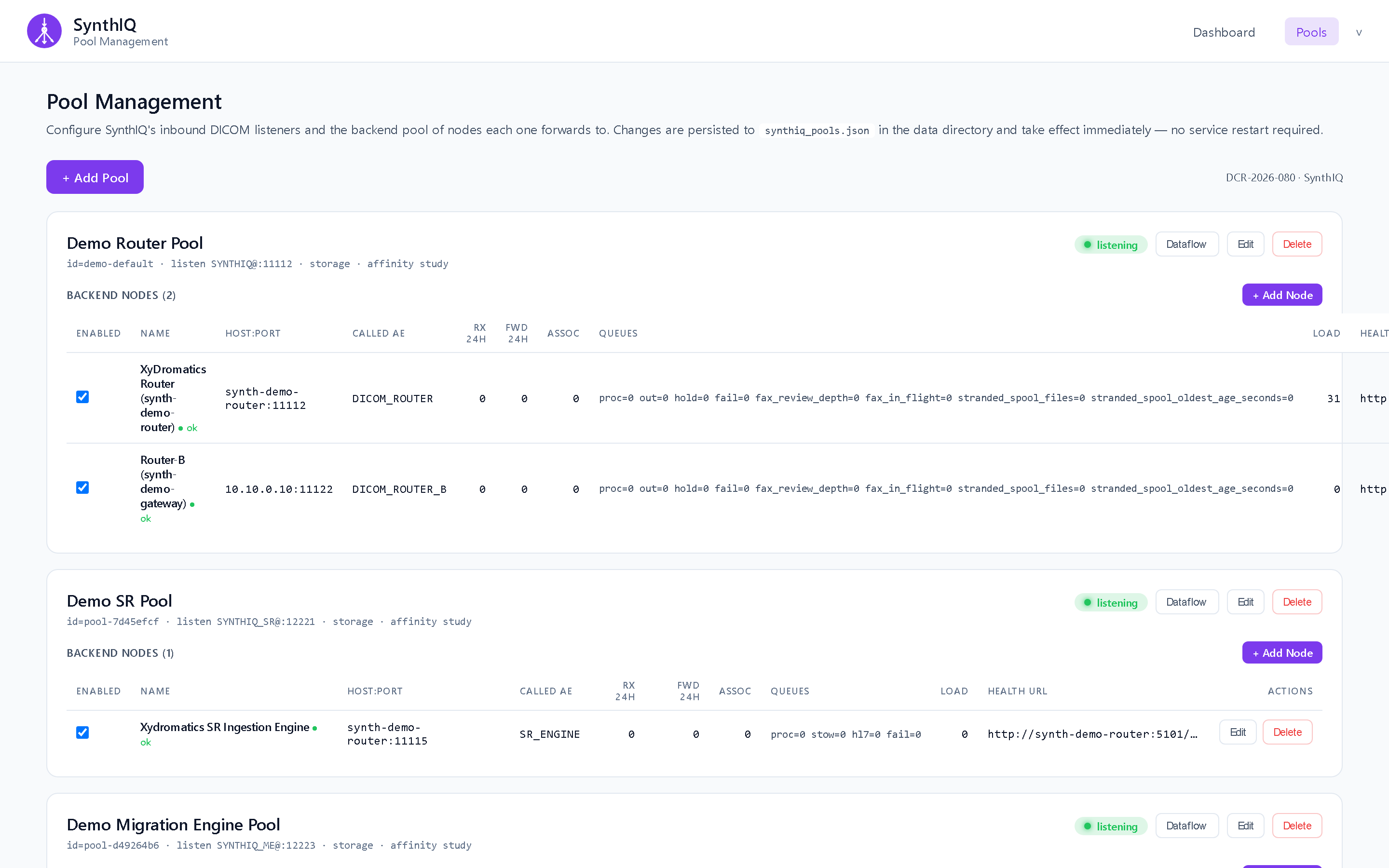
Pool management
One DICOM AE title in front of many applications: each pool lists its members, their live health and load, and the routing strategy that spreads studies across them.
Between your modalities and your backend pool — wherever a
generic L4 load balancer lives today. Modalities don't change
their config; backends don't change their config; SynthIQ
replaces the LB at the same VIP and starts routing by
Study Instance UID.
SynthIQ is a single self-contained binary on Windows or Linux.
Running two or more nodes over a shared external affinity store
— PostgreSQL or SQL Server rather than the default in-process
store — is included with every licence, not gated behind a tier. For full architectural depth — three-tier routing
waterfall, persistent affinity store internals, failure-mode
analysis — see
§3 of the whitepaper.
Performance · Measured
The heaviest studies, on the smallest box.
We put SynthIQ on a dedicated performance rig — a
2 vCPU / 8 GB instance, the smallest a cloud will
rent — and measured it under the worst DICOM workloads: 3D
tomosynthesis and 10,000-slice CT. Because SynthIQ routes rather than
renders — it never decodes or buffers pixels; it spools to disk and
streams — memory is never the wall.
accepted by the 8 GB box (35 GB DBT + 30 GB CT), no failed object
0
memory leaks — heap plateaus under sustained load
Workload (on 2 vCPU / 8 GB)
Volume
Accepted
Peak heap
3D tomosynthesis (DBT)
70 studies / 35 GB
100%
490 MB
High-count CT (incl. 10,000-slice "Alpha CT")
30,000 objects / 30 GB
100%
620 MB
The honest nuance: 2 vCPU / 8 GB
never fails on memory or correctness for any modality — but
throughput scales with cores. A single 10,000-slice
study clears in minutes on a small box, and faster on more vCPU — though
with diminishing returns: 2 to 8 vCPU bought 25% on our rig, most of it by 4. Size SynthIQ for the throughput you need, not to survive the
biggest study. Full rig methodology, run-by-run tables, and why the
memory ceiling isn't there:
the SynthIQ capacity whitepaper.
Common use cases
Five deployment patterns.
Pattern 1
Replace a generic L4 LB in front of a PACS pool
The flagship deployment. You run F5, NetScaler, or HAProxy in front of 3-5 backend nodes today. Studies scatter across nodes, so no node holds a whole study — a re-send or re-route duplicates fragments at the destination, and per-node counts disagree. SynthIQ is a drop-in replacement at the same VIP.
Flow
1Modalities continue to point at the same VIP (no modality-side change)
2SynthIQ replaces the generic LB at the VIP
3SynthIQ routes each C-STORE by Study Instance UID to the same backend
4Each study lands whole on one backend — re-sends and re-routes to other destinations go from a single source, with no duplicate fragments
5Cut over from existing LB during a maintenance window with rollback ready
Pattern 2
Front a heterogeneous DICOM pool (multi-vendor backends)
You have a Router pool plus a legacy PACS plus a research VNA, and modalities need to route to one VIP that fans out. SynthIQ's vendor-neutral design supports a mixed pool: any DICOM-conformant backend qualifies as a pool member.
Flow
1Configure SynthIQ pool with backends spanning Router instances + non-Synthology PACS + research VNA
2Health-check endpoint is the only requirement per backend
3New studies route by least-busy across the mixed pool
4Affinity binds studies to their initial backend regardless of vendor
Pattern 3
Bridge a PACS migration cutover (study-affinity preservation)
During a PACS replacement, the old archive and new archive both run. Studies need to keep going to their original archive (until they're fully migrated) while new studies go to the new archive. SynthIQ's affinity store doubles as a deterministic routing rule across the cutover.
Flow
1SynthIQ pool includes both old archive and new archive as backends
2A study SynthIQ has already routed keeps going to the same archive automatically — its per-Study-UID binding was recorded on the first instance and is honored for the cache window
3Mark the old archive as a lower-priority backend so unbound (new) studies land on the new one, while affinity-bound studies still follow their binding
4Migration completes; old archive removed from pool; affinity bindings re-point to new archive
Pattern 4
Distribute to AI vendor + production pool in parallel
AI vendor wants a copy of every CT. Production PACS pool serves clinical reads. SynthIQ fans out: production pool gets the routed copy (with affinity), AI vendor gets every study unconditionally.
Flow
1Configure SynthIQ pool A (production, study-affinity routing) for clinical workflow
2Configure SynthIQ pool B (AI vendor, fanout to single AI endpoint) on a separate listener
3Modality forwards each instance to both VIPs
4Pool A maintains affinity; Pool B unconditionally forwards to AI
Pattern 5
Dedicated lane for STAT / urgent studies
Priority work shouldn't queue behind routine volume. Stand up a separate pool with its own AE title, port, and VIP, pointed at a specialized or faster backend; a modality operator chooses the lane by sending an urgent study to that AE title, putting it on a path that runs independently of the routine pool. The clinical decision of what is urgent stays with the operator — SynthIQ provides the dedicated pool and faithfully delivers to it.
Flow
1Configure a dedicated pool with its own AE title + port for priority traffic
2Point it at the specialized / priority backend (or a faster Router)
3A modality operator manually selects that AE title (destination) for a STAT study
4The urgent study takes the priority lane; the routine pool keeps its own affinity + least-busy balancing, unaffected
Integration points
What SynthIQ connects to.
Vendor-neutral on every layer. Any DICOM-conformant backend qualifies as a pool member.
Backends (the pool members)
XyDromatics Router — first-class integration via /api/health
XyDromatics Repository / Migration / Clinical / Research — same /api/health
GE Centricity, Siemens syngo.plaza, Philips Vue, Fujifilm Synapse, Merative Merge — any vendor PACS with a health endpoint
Optional integration with Synthology SynthGateway for fleet-wide health telemetry
Availability
SynthIQ itself runs as a pair.
If SynthIQ is what keeps the pool available, the fair question is
what keeps SynthIQ available. The answer is to run two or more
nodes over a shared external affinity store —
PostgreSQL or SQL Server rather than the default in-process store
— so the record of which study went where lives outside any
single node.
Because affinity is external, losing a node loses neither the
affinity nor the in-flight work: the surviving node already knows
where every study was going. And you can confirm the deployment is
genuinely configured that way rather than take it on trust —
the health endpoint reports whether the affinity store is external.
SQLite affinity, single instance, single pool. Measured: every object of a concurrent 3D tomosynthesis and 30,000-object CT workload accepted and acknowledged, no failures, at this exact spec. That is an acceptance count, not a delivery measurement.
Standard / community hospital
200 – 1,500 studies / day
4 vCPU
8 – 16 GB
100 GB
SQLite or PostgreSQL affinity, single instance, multi-pool if needed. Cores add throughput headroom; RAM stays modest.
High-throughput / academic
1,500 – 8,000 studies / day
8 vCPU
16 GB
100 GB per node
PostgreSQL or SQL Server shared affinity; active-active HA pair for resilience. Cores — not RAM — drive the tier.
Enterprise / IDN
> 8,000 studies / day
8 – 16 vCPU (HA pool, 2+ nodes)
16 GB per node
100 GB per node
Scale OUT — add SynthIQ pool nodes, not bigger boxes. PostgreSQL or SQL Server shared affinity; multi-region considerations.
SynthIQ's own memory footprint stays well under 1 GB regardless of tier
(see Performance · Measured above) — it routes, it doesn't render. The RAM
above is comfortable headroom for the OS, a co-located affinity database,
and burst concurrency; cores and concurrency — not memory — set the tier.
Licensing
Standard and Enterprise.
SynthIQ Standard
The base package — DICOM-aware load balancing, persistent affinity, admin SPA.
Single-pool DICOM Storage SCP
Persistent study affinity (SQLite, PostgreSQL, or SQL Server)
Health-aware backend selection
Admin SPA with full read and write — pool and backend-node CRUD plus settings pages, each RBAC-gated
Structured logging
SynthIQ Enterprise
Multi-pool deployments + HA + advanced operational tooling.
Everything in SynthIQ Standard
Multiple parallel pools (fanout, segmentation)
Run two or more nodes over a shared external affinity store — either node can answer for any study (included, not tier-gated)
Premium support tier eligible
Documentation
The controlled-document set.
Current GA release
v1.0.3.200·released 2026-08-06
Every SynthIQ deployment ships with the documents below, all managed under SynthQMS document control. The DICOM Conformance Statement is publicly available; the rest are shared under mutual NDA.
What’s new·v1.0.3.200
Smarter per-study routing, graceful pool maintenance, and easier configuration
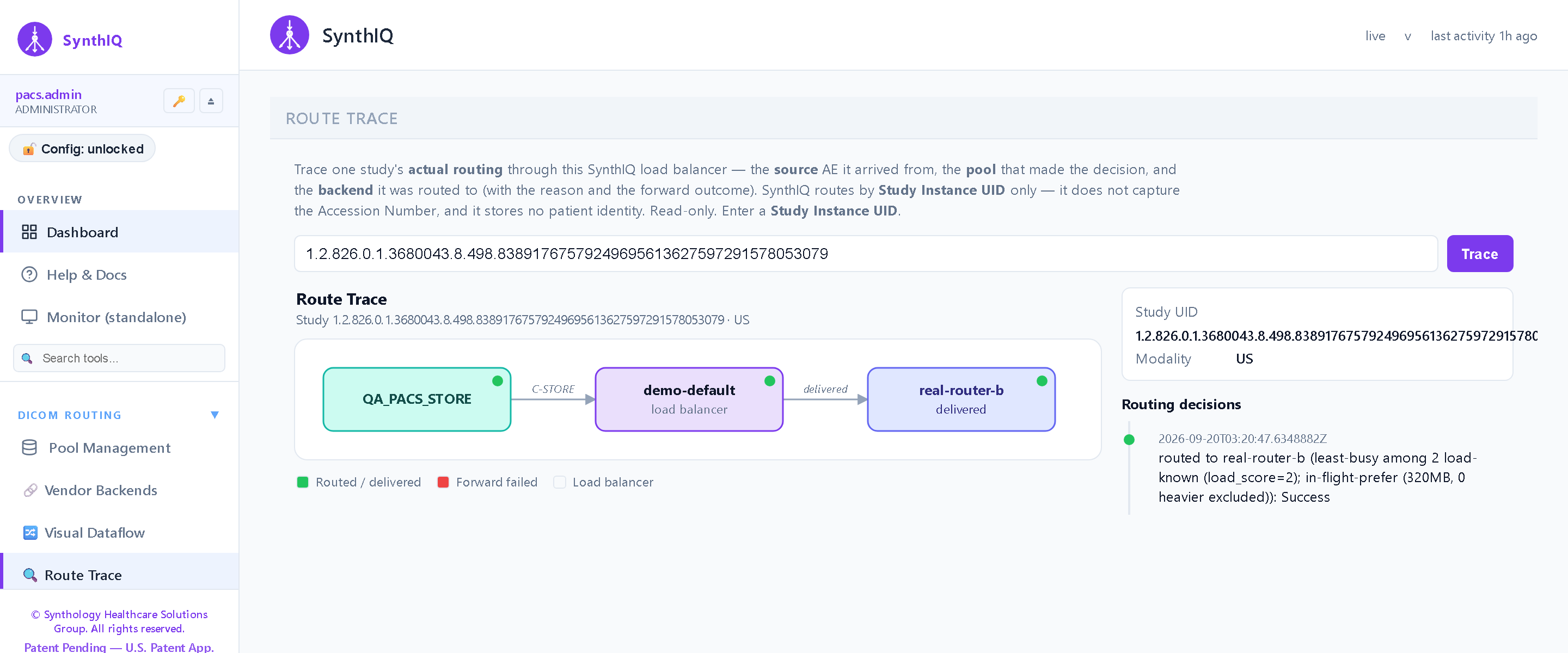
▸Per-study Route Trace — confirm which healthy backend each study was balanced to, and why, from a right-click on any recent routing decision.
▸Per-backend outbound-forwarding state, so delivery to each pool member is confirmed from the backend’s own acknowledgement.
▸Configuration export / import and fleet configuration sync, with a config-edit lock so only one administrator edits at a time.
▸Graceful maintenance — pause a pool’s DICOM listener and let in-flight transfers finish before taking a backend down for service.
▸Broader DICOM compatibility and online license activation, plus refreshed in-app Help and license materials.
Document
Title
Notes
DOC-2026-348
Hardware & Software Requirements (SynthIQ)
Sizing, OS support, dependencies
DOC-2026-347
DICOM Conformance Statement (SynthIQ)
Public — full SOP class + transfer-syntax matrix
DOC-2026-350
EULA Annex (SynthIQ)
Annex to the Synthology Master EULA (DOC-2026-063)
DOC-2026-395
Penetration Test Results (SynthIQ)
Available under NDA
DOC-2026-396
QA Runner Manual (SynthIQ)
Internal QA + customer-validated test runs
DOC-2026-353
User Guide (SynthIQ)
Operator + administrator workflows
DOC-2026-351
Installation Guide (SynthIQ)
Includes MSI deploy + Linux tarball install
Frequently asked
The questions prospects ask.
Is SynthIQ tied to the Synthology fleet? Can we use it with our existing non-Synthology PACS?
SynthIQ is **completely vendor-neutral**. It speaks standard DICOM to any backend. Mixed pools are explicitly supported: Router instances + non-Synthology PACS + research VNA can all live in one SynthIQ pool. Any DICOM-conformant backend qualifies as a pool member as-is — nothing to build to join. For *first-class* least-busy routing, a backend reports its load one of three ways: implement the published SynthIQ Health Contract (one small endpoint), let us adapt its existing health metrics, or run heartbeat-only and be balanced by weight. Three doors, no dead ends — see the Vendor-neutral pools section above.
How is this different from running iRules on F5 to parse DICOM?
You can write F5 iRules / NetScaler responder policies that parse DICOM headers. Customers who've done it report 2-4 weeks of engineering plus ongoing maintenance burden, and the iRules don't survive F5 firmware upgrades cleanly. SynthIQ ships this as the product's first-class behavior, with a persistent SUID→backend cache that no iRule can provide (iRules are stateless per-connection).
We already run an F5 or NetScaler. Why add SynthIQ?
Your F5 balances TCP connections; it can't see a DICOM study or an ingest queue, so it scatters the instances of one exam across backends and floods whatever node it last hashed to. SynthIQ replaces it **on the imaging path only** — studies stay whole, routing follows real reported backend load, and it's a software binary rather than another appliance license. Keep your F5 / NetScaler for the rest of your traffic; SynthIQ owns the DICOM path.
Will it be as smart with our GE / Siemens / Sectra PACS as with Synthology's own products?
It's smartest with any backend that reports its load — Synthology products do that natively, and any vendor can via the published SynthIQ Health Contract or by letting us adapt their existing metrics. A backend that can only answer a heartbeat still gets reliable failover and weighted distribution — just not queue-depth least-busy. We never pretend to know a load a backend didn't report, and we never flood one we can't measure.
What do we have to build to put our system in a SynthIQ pool?
Nothing to be a pool member — any DICOM-conformant backend qualifies today. For first-class least-busy routing you have **three doors**: implement one small endpoint (the SynthIQ Health Contract) and self-certify, let us write an adapter onto your existing metrics, or run heartbeat-only and be balanced by weight. None of them is a dead end.
What's the regulatory classification?
Non-device software under FD&C Act §520(o)(1)(D) — the statutory carve-out (21st Century Cures Act §3060, 2016) for software solely transferring, storing, converting formats, or displaying medical device data. The classification rests on three properties: SynthIQ stores no clinical data (DICOM payloads pass through, only routing metadata persists), performs no payload transformation (bytes received = bytes forwarded), and routes on study identity (SUID) rather than clinical content.
What happens if SynthIQ goes down mid-association?
In-flight C-STOREs error to the modality, which retries — this is standard DICOM behavior and no different than any other proxy outage. The affinity cache is persistent, so SynthIQ comes back up with state intact and same-SUID retries route to the original backend. No study fragmentation.
How long does a typical POC take?
30 days from initial config to bridge-and-decommission of your existing L4 LB. Week 1: install + configure pools + bind affinity cache. Week 2: parallel-run alongside existing LB with same backends. Week 3: cut over half the modalities to SynthIQ; monitor. Week 4: full cutover + decom of old LB.
Does SynthIQ replace XyDromatics Router?
No, they're complementary. Router is a full DICOM workflow product with rule engine, tag transformation, anonymization, hold queue, prefetch. SynthIQ is a load balancer. Many customers run SynthIQ in front of a Router pool — SynthIQ does affinity routing into the pool, each Router instance does its own workflow logic, results are coherent.
What's the upgrade path?
Patch releases (1.X.Y.Z) deploy without downtime via active-active HA on Enterprise. On Standard, a brief maintenance window is required during binary swap. Minor releases (1.X.Y) typically follow a quarterly cadence. Affinity-cache schema evolves with zero-downtime migrations; cache state persists across upgrades.
See SynthIQ in action.
30-day POC. Install in front of your existing DICOM pool alongside
your current LB; measure scatter reduction with your real
workload; cut over when you're satisfied. We can be set up in
your environment within a week.